Your comprehensive roadmap to navigating the regulatory, security, and data protection requirements for Germany’s two-pillar cannabis system—from cultivation associations to commercial pilot programs.
Introduction: Germany’s Two-Pillar Cannabis System
Germany’s landmark Cannabis Act (Cannabisgesetz, or CanG) came into force on April 1, 2024, fundamentally reshaping how Europe’s largest economy approaches cannabis regulation. With a population of 83 million people and a medical cannabis market that exceeded €450 million in 2024, Germany has positioned itself as the de facto leader in EU cannabis policy reform.
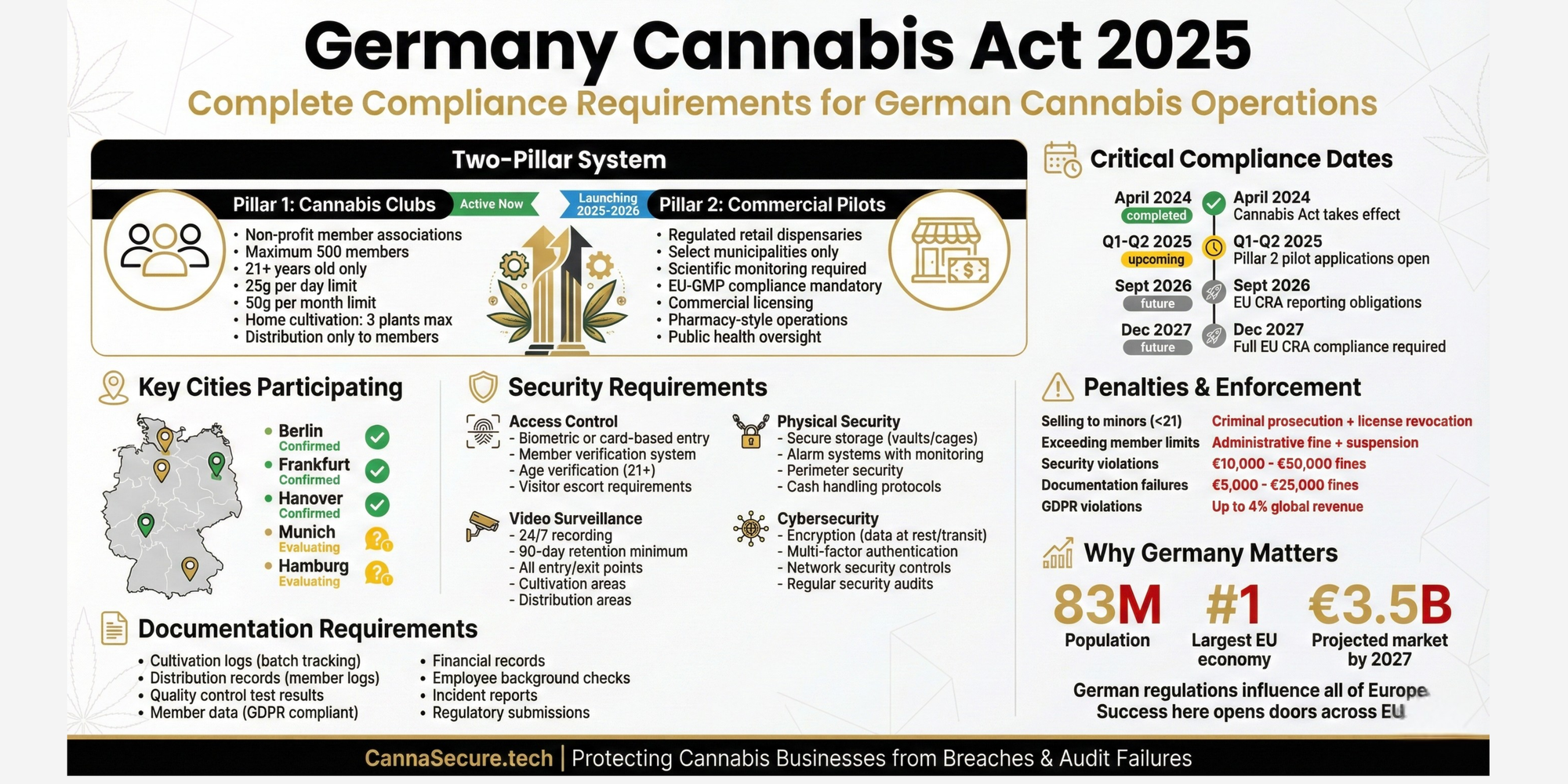
The German model operates through a distinctive two-pillar framework:
Pillar 1: Personal Use and Cultivation Associations (Active since April/July 2024)
The first pillar decriminalized personal cannabis possession and enabled adults to cultivate small quantities at home. More significantly, it established the legal framework for Cannabis Cultivation Associations (Anbauvereinigungen), non-profit member organizations that collectively grow and distribute cannabis to their members. As of May 2025, approximately 660 license applications have been submitted nationwide, with roughly 237 permits granted—though implementation varies significantly by federal state.
GDPR Compliance for Cannabis Dispensaries: The Complete 2025 GuideYour comprehensive roadmap to EU data protection compliance—before regulators come knocking GDPR Cannabis Compliance 2025: The Complete Security & Data Protection Guide for EU Cannabis BusinessesThe definitive guide to navigating Europe’s strictest data protection requirements for cannabis dispensaries, medical cannabis operators, and cultivation facilities. Canna SecureProtecting Cannabis Businesses from Canna SecureCannaSecure
 Pillar 2: Commercial Pilot Projects (Launching 2025-2026)
The second pillar envisions federally approved, scientifically supervised pilot projects in select municipalities, allowing strictly limited adult-use cannabis sales through designated retailers or pharmacies. Cities including Berlin, Frankfurt, and Hanover have submitted applications to the Federal Office for Agriculture and Food (BLE), with 49 pilot applications received as of mid-2025. While no project has received full federal approval yet, first retail sales are projected for late 2025 or early 2026.
Why German Compliance Matters for the EU
Germany’s approach carries disproportionate influence across the European Union. As the largest market in the bloc, German regulatory standards effectively set precedents that neighboring countries watch closely. The EKOCAN evaluation (Germany’s federally mandated assessment of the Konsumcannabisgesetz) published in October 2025 showed early success: legal supply is growing, the black market is shrinking, and cannabis-related criminal offenses have declined significantly.
For businesses, investors, and operators considering the German market, understanding the complete compliance landscape—from physical security to data protection to cybersecurity—is not optional. It’s the price of entry.
Section 1: Cannabis Club Security Requirements (Pillar 1)
Cannabis Cultivation Associations operate under strict regulatory oversight designed to prevent diversion, protect minors, and ensure product quality. Any organization seeking or holding a cultivation license must implement comprehensive security measures across five primary domains.
Member Verification and Access Controls
Cultivation associations must implement rigorous member verification systems that go far beyond simple ID checks:
Mandatory Verification Requirements:
- All members must be at least 18 years old and have maintained residency in Germany for a minimum of six months
- Individuals may only hold membership in one cultivation association at a time
- The association must maintain a minimum membership duration of three months (specified in statutes)
- Maximum membership is capped at 500 members per association
- Board members must submit police clearance certificates and business central register extracts
Access Control Implementation:
- Electronic or physical access control systems must be installed at all entry points
- Member identification must be verified at each visit
- Visitor logs must be maintained with timestamps
- Access to cultivation areas must be restricted exclusively to members and authorized personnel
- Children and juveniles may not be given access to association premises under any circumstances
Cultivation Facility Physical Security
The KCanG mandates that cultivation associations implement measures ensuring cannabis plants, products, and propagating materials are protected from unauthorized access:
Perimeter Security:
- Enclosed, secured property with protection against unauthorized access
- Minimum 200-meter distance from schools, children’s and youth facilities, and playgrounds
- Facilities cannot be located inside residential dwellings or on properties used for housing
- Adequate fencing or barriers preventing visual and physical access
Internal Security:
- Secure storage areas for harvested cannabis, seeds, and cuttings
- Locked storage when staff are not present
- Environmental controls to protect product integrity
- Fire suppression and detection systems
- Alarm systems connected to monitoring services
Inventory Tracking and Documentation
All cultivation associations must maintain detailed records of their operations:
Required Documentation:
- Complete member registry with contact details, verification documents, and membership dates
- Cultivation logs tracking plant counts, growth stages, and environmental conditions
- Harvest records including quantities (grams), separated by marijuana and hashish
- Distribution records documenting which member received what quantity and when
- Seed and cutting inventory with source documentation
- Destruction records for waste materials and non-viable product
Reporting Obligations:
- Regular reports to state authorities as specified by local requirements
- Notification of changes to association structure, board members, or facility location
- Annual verification submissions to maintain licensing
Distribution Controls
The law imposes strict limits on what, when, and how much cannabis can be distributed:
Per-Member Limits:
- Adults 21+: Maximum 25 grams per day, 50 grams per month
- Adults 18-21: Maximum 25 grams per day, 30 grams per month, with THC content capped at 10%
- Seeds: Up to 7 per month per member
- Cuttings: Up to 5 per month per member (combined seeds and cuttings cannot exceed 5 if both are provided)
Distribution Requirements:
- Cannabis may only be distributed as pure marijuana (dried flowers) or hashish (separated resin)
- No edibles, concentrates made with solvents, or processed products
- On-site consumption is prohibited—both within the facility and within 100 meters of the entrance
- Shipping and delivery are prohibited; members must collect in person
- No advertising, marketing, or sponsorship in any form
Protection of Minors
Youth protection represents a central pillar of the Cannabis Act, with violations carrying severe penalties:
Required Safeguards:
- Strict age verification at all access points
- Appointment of designated prevention officers (Präventionsbeauftragte) with documented expertise
- Cooperation with local addiction prevention and counseling centers
- Distribution of addiction prevention information to all members
- Posted signage regarding age restrictions and health risks
Criminal Penalties for Violations:
- Supply of cannabis to minors by persons over 21 carries a minimum sentence of two years imprisonment (increased from one year under previous law)
- Persons convicted of cannabis-related offenses may not employ or train juveniles
Section 2: Pillar 2 Commercial Pilot Requirements
While Pillar 1 is operational, Germany’s commercial pilot projects represent the more significant long-term opportunity for cannabis businesses—and the more complex compliance challenge.
 cannabisrisk.diy
Participating Municipalities
The Federal Office for Agriculture and Food (BLE) is reviewing applications from municipalities seeking to host commercial cannabis pilot projects. As of late 2025, the leading candidates include:
Active Contenders:
- Berlin (multiple districts have submitted proposals)
- Frankfurt am Main
- Hanover
- Hamburg (exploratory)
- Additional municipalities across approximately 49 submitted applications
Each pilot project requires separate federal approval from the German Ministry of Food and Agriculture (BMEL), with additional ethics clearance and scientific protocol vetting. Geographic diversity is expected, but every project will operate within a tightly defined catchment area.
Licensing Application Requirements
Prospective pilot participants must demonstrate comprehensive capability across multiple domains:
Required Documentation:
- Partnership agreements with scientific, academic, or public health institutions
- Detailed research protocols for data collection and health monitoring
- Comprehensive security and compliance plans
- Facility specifications meeting pharmaceutical-grade standards
- Financial capability and sustainability assessments
- Qualified personnel with demonstrable expertise in cannabis operations
Operational Commitments:
- Strict enrollment caps limiting participation to local residents
- Mandatory participant registration with ID verification, proof of address, and baseline surveys
- Age minimum of 18+ (municipalities may impose higher limits)
- Purchase limits aligned with personal possession caps (projected around 25g per transaction)
- Transaction logging against registered participant IDs
EU-GMP and GACP Compliance Standards
Commercial cannabis operations in Germany must meet European pharmaceutical manufacturing and agricultural standards:
Good Agricultural and Collection Practices (GACP):
GACP governs cultivation and raw plant handling and is typically required for obtaining cultivation licenses. Key requirements include:
- Standardized cultivation processes ensuring reproducible results
- Documented seed selection, cultivation conditions, and harvesting methods
- Qualification of critical equipment and ancillary systems
- Pest management and contamination prevention protocols
- Post-harvest handling procedures including drying and curing specifications
EU-GMP (Good Manufacturing Practices):
EU-GMP is legally binding for any entity manufacturing, processing, or importing cannabis-based medicines in the EU:
- Facilities must meet strict criteria for hygiene, traceability, personnel competence, and quality control
- Regular audits by national regulatory agencies (in Germany, state-level authorities issue manufacturing permits)
- Full validation protocols, qualification reports, standard operating procedures (SOPs), and quality manuals
- Appointment of Qualified Persons (QPs) meeting requirements under the Medicinal Products Act (AMG)
- Complete batch documentation and release procedures
Transition Point: GACP applies through cultivation and initial post-harvest processing. EU-GMP Part II becomes applicable starting at trimming and drying, with EU-GMP Part I governing all subsequent manufacturing through final product release.
Scientific Oversight Obligations
Pillar 2 is explicitly designed as a research framework, not merely a commercial licensing program:
Data Collection Requirements:
- Rigorous anonymized data capture on all participants
- Consumer behavior tracking (purchase frequency, quantity patterns, product preferences)
- Health outcome monitoring (adverse events, mental health indicators)
- Black market displacement metrics
- Youth access prevention effectiveness
Institutional Partnerships:
- All pilots must operate in conjunction with academic, scientific, or public health institutions
- Research protocols must receive ethics committee approval
- Regular reporting to federal authorities on research findings
- Contribution to the comprehensive evaluation mandated by the CanG
Timeline and Deadlines
The current trajectory for Pillar 2 implementation:
Milestone Projected Date
Federal regulatory framework finalization Early 2026
First pilot project approvals Q1-Q2 2026
Initial retail sales (first approved pilots) Late 2025 - 2026
Comprehensive CanG evaluation 2028 (four years post-implementation)
Political uncertainty remains a factor. The coalition government formed in spring 2025 (CDU/CSU and SPD) has committed to an “open-ended evaluation” of the Cannabis Act in autumn 2025. While a complete rollback appears unlikely given SPD support for legalization and coalition dynamics, stricter regulations remain possible—particularly for the recreational sector.
Section 3: German Data Protection Requirements
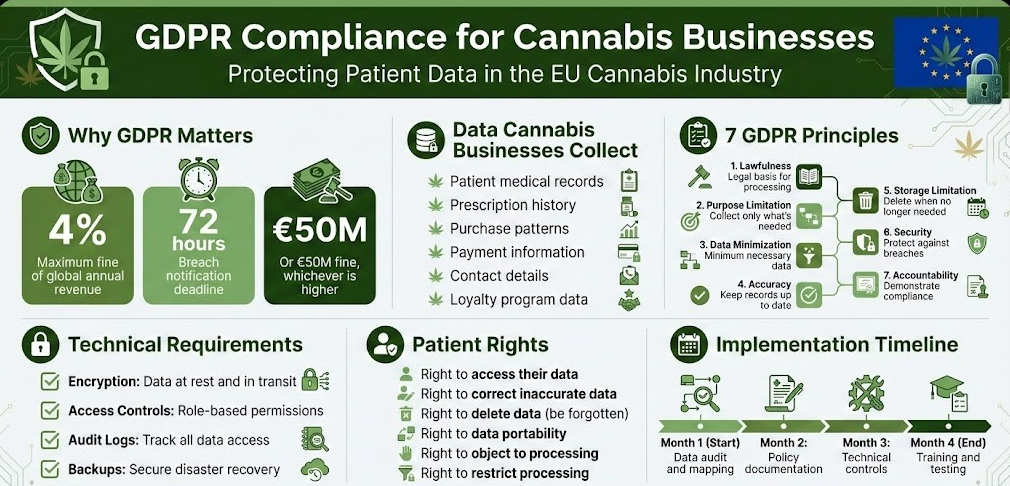
Operating any cannabis business in Germany means navigating one of the world’s most stringent data protection environments. The combination of the EU’s General Data Protection Regulation (GDPR) and Germany’s Federal Data Protection Act (Bundesdatenschutzgesetz, or BDSG) creates extensive obligations for any organization processing personal data.
GDPR and BDSG Framework
Dual Regulatory Structure:
The GDPR applies directly across all EU member states, establishing baseline requirements for data collection, processing, storage, and transfer. Germany has supplemented this framework through the BDSG, which exercises the GDPR’s “opening clauses” to specify additional requirements in areas including employment data processing and data protection officer appointments.
Key Principles:
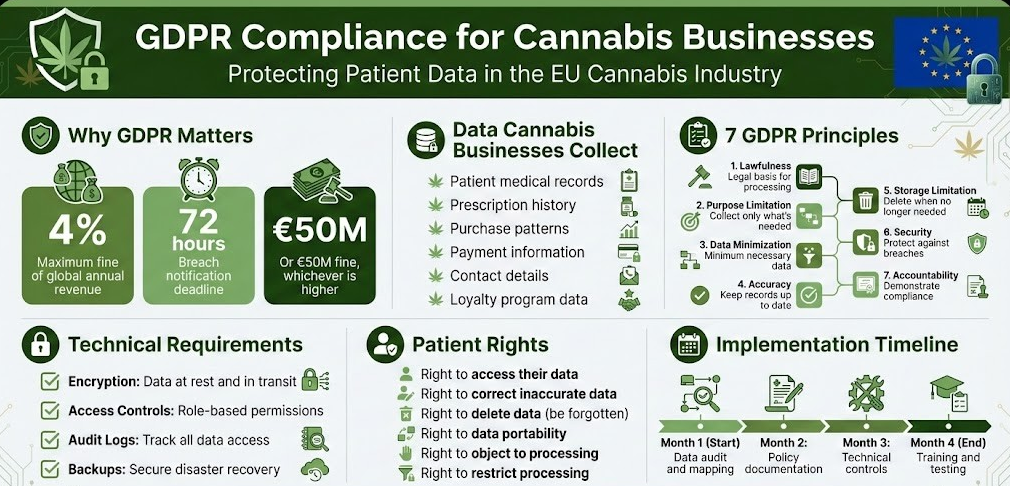
- Lawfulness, Fairness, and Transparency: Data processing must have a legal basis, typically consent or legitimate interest
- Purpose Limitation: Data collected for one purpose cannot be repurposed without additional consent
- Data Minimization: Collect only what is necessary for the stated purpose
- Accuracy: Maintain current, correct information
- Storage Limitation: Retain data only as long as necessary
- Integrity and Confidentiality: Implement appropriate security measures
- Accountability: Document compliance and be prepared to demonstrate it
Member Privacy in Cannabis Clubs
Cultivation associations process sensitive personal data by their very nature—membership in a cannabis organization reveals information about an individual’s substance use, which constitutes special category data requiring enhanced protections:
Consent Requirements:
- Explicit, informed consent for membership data processing
- Clear privacy notices explaining what data is collected, why, and how long it will be retained
- Right to withdraw consent and request data deletion (subject to regulatory retention requirements)
Data Minimization Practices:
- Collect only information necessary for legal compliance and operations
- Avoid collecting health information beyond what’s legally mandated
- Limit access to member data on a need-to-know basis
Security Obligations:
- Encryption of electronic records containing personal data
- Secure physical storage for paper records
- Access controls limiting data access to authorized personnel
- Regular security assessments and updates
Patient Data for Medical Cannabis
Medical cannabis operations face additional requirements under healthcare data protection regulations:
Prescription Data:
- Medical cannabis prescriptions contain health data requiring the highest protection levels
- Pharmacies must implement systems preventing unauthorized access to patient records
- Transmission of prescription data must use encrypted channels
Research Data:
- Clinical trial participants have specific rights under GDPR Article 89
- Anonymization or pseudonymization required for research datasets
- Ethics committee approval required for any research involving personal data
Employee Background Checks
German law permits background checks for employees but imposes limitations:
Permitted Checks:
- Police clearance certificates (Führungszeugnis) for board members and prevention officers
- Business central register extracts for responsible persons
- Verification of professional qualifications for positions requiring specific expertise
Limitations:
- General criminal history checks for all employees are not automatically permitted
- Health data may only be processed where directly relevant to job requirements
- Social media screening without consent is generally prohibited
BDSG Section 26 Requirements:
- Employee data processing must be necessary for the employment relationship
- Monitoring activities must be proportional and documented
- Works council consultation may be required for monitoring systems
Data Retention Requirements
Cannabis operations must balance competing obligations: regulatory requirements mandate retention of certain records while data protection principles require deletion when data is no longer necessary.
Regulatory Retention:
- Cultivation and distribution records: Maintain for the duration of the license plus the applicable statute of limitations for regulatory violations
- Member data: Retain during membership plus any required post-membership period
- Financial records: 10-year retention under German commercial law (Handelsgesetzbuch)
- Quality control records: Duration specified by GMP/GACP requirements (typically equal to product shelf life plus one year)
GDPR Deletion Rights:
- Data subjects have the right to erasure when data is no longer necessary
- Retention beyond necessity requires a legal basis (regulatory compliance qualifies)
- Documented retention policies must explain the legal basis for continued storage
Section 4: Physical Security Standards
Physical security forms the foundation of cannabis compliance. German regulatory authorities expect robust measures that prevent theft, diversion, and unauthorized access while maintaining product integrity.
Facility Access Control Systems
Tiered Access Architecture:
Implement a layered access control system with increasing restriction levels:
- Public Zone: Reception areas, limited to identity verification
- Controlled Zone: Administrative offices, member services—access limited to staff and registered members
- Secure Zone: Cultivation areas, storage vaults—access limited to authorized personnel with documented need
- Restricted Zone: Processing areas, high-value inventory—minimum personnel access, dual-control where appropriate
Technology Requirements:
- Electronic access control (keycards, biometric systems, or combination)
- Time-stamped access logs retained for regulatory review
- Automatic lockout procedures after hours
- Visitor management systems with ID verification and escort requirements
- Integration with video surveillance for audit trails
Video Surveillance Requirements
While the KCanG does not specify detailed surveillance requirements, best practices aligned with EU-GMP and state-level guidance include:
Coverage Areas:
- All entry and exit points
- Cultivation rooms
- Harvest and processing areas
- Storage vaults and safes
- Distribution/dispensing areas
- Perimeter and parking facilities
Technical Specifications:
- Minimum resolution sufficient for individual identification
- Timestamp synchronization with access control systems
- Minimum 30-day retention of recordings (longer where required by state authorities)
- Secured, tamper-evident storage of recordings
- Backup systems ensuring continuity during power outages
GDPR Compliance:
- Signage notifying individuals of surveillance
- Privacy impact assessment for CCTV systems
- Data protection policies addressing surveillance footage
- Limited access to recordings (security personnel and authorized investigators only)
Alarm Systems and Monitoring
Required Capabilities:
- Intrusion detection covering all access points and secure areas
- Motion sensors in high-value storage areas
- Glass-break detection where applicable
- 24/7 monitoring by licensed security provider or direct police connection
- Battery backup for minimum 24-hour operation during power outages
- Regular testing and maintenance documentation
Response Protocols:
- Documented procedures for alarm events
- Contact lists for management notification
- Coordination protocols with local law enforcement
- Post-event review and documentation requirements
Secure Storage Requirements
Cannabis Product Storage:
- Lockable storage rated for valuables
- Access limited to specifically authorized personnel
- Inventory reconciliation procedures (daily or per-transaction)
- Environmental controls maintaining product quality
- Separate storage for different product categories and batches
Seeds and Propagating Materials:
- Secure storage preventing unauthorized access
- Source documentation for all genetic materials
- Chain of custody records from acquisition through cultivation
Records and Documentation:
- Fire-resistant storage for critical documents
- Encrypted electronic storage with access controls
- Off-site backup for disaster recovery
Transport Security Protocols
While cultivation associations cannot ship or deliver cannabis to members, transport may occur for:
- Movement of cultivation materials between approved locations
- Transport of samples for testing
- Medical cannabis distribution (for licensed distributors)
Transport Requirements:
- Secure, locked compartments in vehicles
- GPS tracking for commercial transport
- Manifest documentation accompanying all shipments
- Chain of custody procedures
- Trained personnel with documented background checks
Cash Handling Security
Until German banking fully normalizes cannabis transactions (still an ongoing challenge), many operations rely significantly on cash:
Recommended Controls:
- Commercial-grade safes with time-delay locks
- Dual-control procedures for cash counts
- Armored transport for bank deposits
- CCTV coverage of all cash handling areas
- Regular, unscheduled audits
- Insurance coverage appropriate for cash operations
Section 5: Documentation and Record-Keeping
Comprehensive documentation serves multiple purposes: regulatory compliance, quality assurance, liability protection, and operational optimization. German authorities expect detailed, contemporaneous, and accessible records across all operational domains.
Cultivation Logs and Batch Tracking
Plant-Level Documentation:
- Unique identifiers for each plant or batch
- Genetic source and verification (seed lot, cutting source)
- Planting date and growth stage tracking
- Environmental conditions (temperature, humidity, light cycles)
- Nutrient applications with dates and quantities
- Pest management activities and products used
- Growth observations and anomalies
Batch Records:
- Batch identification linked to source plants
- Harvest date and conditions
- Initial weight and subsequent processing weights
- Drying conditions and duration
- Curing parameters
- Final product specifications (THC content, weight)
- Quality control testing results
- Release authorization
Distribution Records
The KCanG mandates tracking of all cannabis distribution to members:
Required Information:
- Member identification (linked to verified registration)
- Date and time of distribution
- Product type and quantity (grams)
- THC content percentage
- Batch identification (traceability to cultivation records)
- Staff member authorizing distribution
- Cumulative tracking (daily and monthly limits)
Format Requirements:
- Records must be maintained in a format accessible to regulatory authorities
- Electronic systems must prevent unauthorized modification (audit trails)
- Paper records must be secured and indexed for retrieval
Quality Control Documentation
Testing Records:
- Laboratory identification and accreditation
- Sample collection procedures and chain of custody
- Test results for cannabinoid content
- Contaminant screening (pesticides, heavy metals, microbial)
- Moisture content verification
- Batch acceptance/rejection decisions
- Corrective actions for failed batches
Equipment Qualification:
- Installation and operational qualification for critical equipment
- Calibration records and schedules
- Maintenance logs
- Performance monitoring data
Adverse Event Reporting (Pharmacovigilance)
While primarily applicable to medical cannabis, cultivation associations should maintain:
Incident Documentation:
- Reports of adverse reactions attributed to products
- Member complaints regarding quality or effects
- Contamination events or product recalls
- Procedures for notifying affected members
Reporting Protocols:
- Escalation procedures for serious events
- Communication with regulatory authorities where required
- Investigation and corrective action documentation
Audit Preparation
German authorities conduct regular inspections of cultivation associations. Audit readiness requires:
Organized Documentation Systems:
- Indexed filing systems (electronic or physical) allowing rapid retrieval
- Current procedure documents accessible to staff
- Training records demonstrating staff competency
- Deviation logs with corrective action documentation
- Self-inspection reports and follow-up actions
Audit Trail Requirements:
- All record modifications must be traceable
- Original entries must remain visible (no overwriting)
- Electronic signatures or initials with dates
- Explanation of corrections or amendments
Required Retention Periods
Record Type Minimum Retention
Member registration and identity verification Duration of membership + statute of limitations
Distribution records 5 years minimum (aligned with regulatory inspection rights)
Cultivation batch records Product lifetime + 1 year
Quality control testing 5 years or as specified by GMP/GACP
Financial records 10 years (German commercial law)
Employee records Duration of employment + statutory limitations
Security system logs 30-90 days (video), 1 year (access logs)
Incident reports 5 years minimum
Section 6: Cybersecurity Requirements
Cannabis operations increasingly depend on digital systems for inventory management, member tracking, financial transactions, and regulatory reporting. This digital dependency creates cybersecurity obligations under multiple regulatory frameworks.
System Access Controls
Authentication Requirements:
- Unique user accounts for all personnel (no shared credentials)
- Strong password policies (minimum length, complexity, rotation)
- Multi-factor authentication for sensitive systems and remote access
- Privileged access management for administrative accounts
- Session timeout and automatic lockout
Authorization Framework:
- Role-based access control aligning permissions with job functions
- Regular access reviews (quarterly recommended)
- Documented approval processes for access grants
- Immediate revocation procedures for terminated personnel
- Segregation of duties for critical operations (e.g., inventory adjustments)
Encryption Standards
Data at Rest:
- Encryption of databases containing personal data (AES-256 or equivalent)
- Encrypted storage for backup media
- Hardware encryption for portable devices
- Key management procedures ensuring key security
Data in Transit:
- TLS 1.2 or higher for all network communications
- VPN for remote access
- Encrypted email for sensitive communications
- Secure file transfer protocols
Network Security
Perimeter Defense:
- Firewall configuration limiting inbound connections
- Intrusion detection/prevention systems
- Network segmentation isolating sensitive systems
- Regular vulnerability scanning and remediation
- Penetration testing (annual recommended)
Internal Controls:
- Endpoint protection on all workstations and servers
- Patch management ensuring timely security updates
- Application whitelisting where feasible
- USB and removable media controls
Vendor Management
Third-party systems and service providers create supply chain cybersecurity risks:
Due Diligence Requirements:
- Security questionnaires for vendors accessing sensitive data
- Contractual security obligations (data processing agreements under GDPR)
- Right to audit provisions
- Incident notification requirements
Ongoing Monitoring:
- Vendor security certification tracking
- Notification requirements for vendor security incidents
- Regular review of vendor access and permissions
Incident Response Obligations
GDPR Breach Notification:
- 72-hour notification requirement to data protection authorities for breaches likely to result in risk to individuals
- Direct notification to affected individuals for high-risk breaches
- Documentation of all breaches (whether or not notified)
Response Plan Requirements:
- Documented incident response procedures
- Defined roles and responsibilities
- Communication templates for stakeholder notification
- Evidence preservation procedures
- Post-incident review and improvement processes
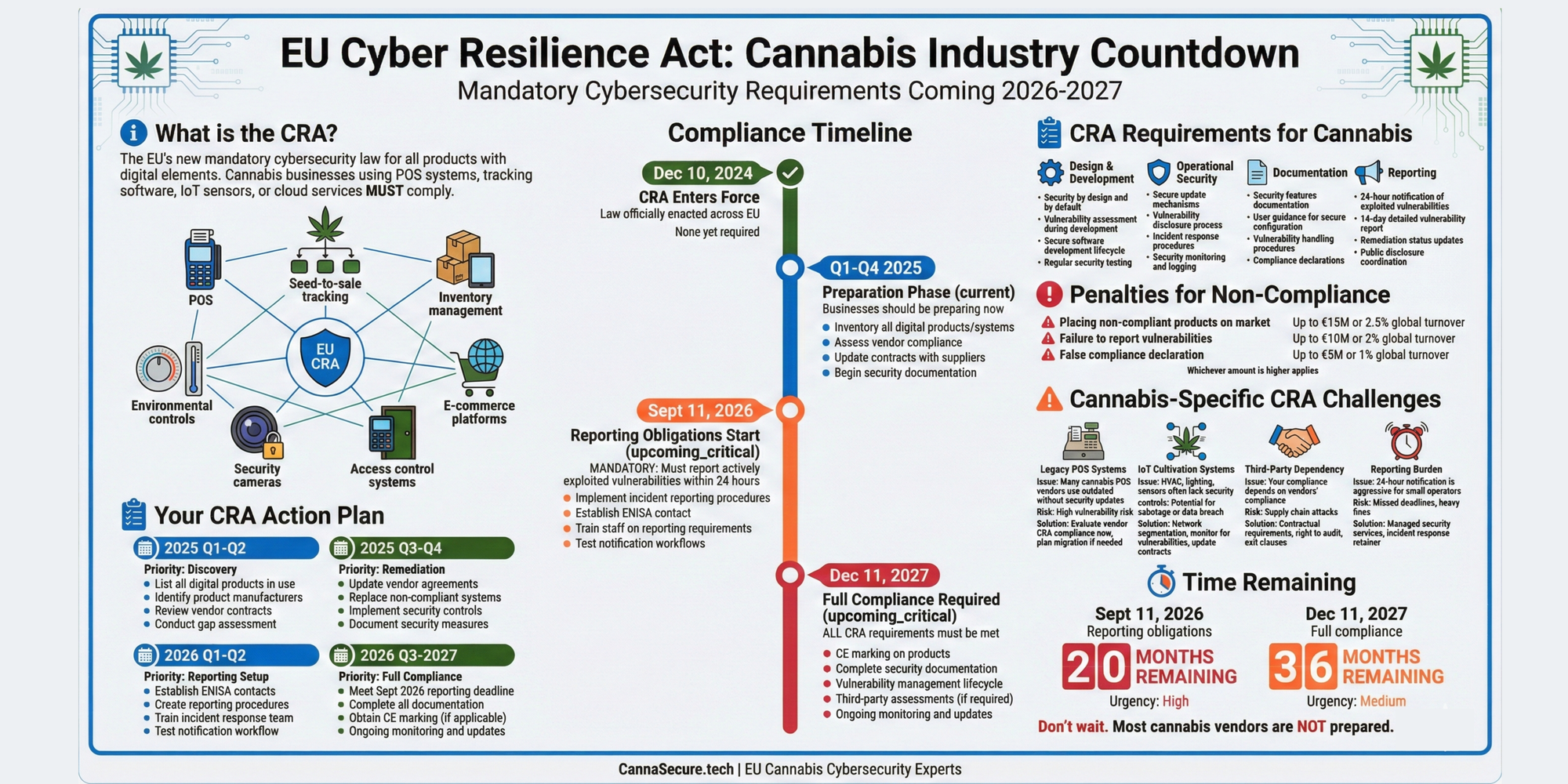
EU Cyber Resilience Act Preparation
The EU Cyber Resilience Act (CRA) entered into force on December 10, 2024, with implementation deadlines approaching:
Key Deadlines:
- September 11, 2026: Mandatory vulnerability reporting and serious incident notifications begin
- December 11, 2027: All CRA requirements fully enforceable
Applicability to Cannabis Operations: The CRA applies to “products with digital elements”—software and hardware products connected to networks. Cannabis businesses using:
- IoT environmental monitoring systems
- Connected security cameras
- Inventory management software
- Seed-to-sale tracking platforms
may need to ensure their technology providers meet CRA requirements or face supply chain disruptions.
Preparation Steps:
- Inventory all products with digital elements in use
- Assess vendor compliance roadmaps for CRA
- Develop vulnerability management procedures
- Establish incident reporting capabilities
In Germany, the Federal Office for Information Security (BSI) serves as the notifying and market surveillance authority, with powers to inspect products and impose sanctions for non-compliance.
Section 7: Compliance Violations and Penalties
Understanding the penalty landscape is essential for risk assessment and compliance prioritization. German cannabis law creates a tiered enforcement structure with administrative, civil, and criminal consequences.
Administrative Fines
The KCanG authorizes administrative fines (Ordnungswidrigkeiten) for various violations:
Maximum Fine Levels:
- General violations of consumption restrictions: Up to €30,000
- Violations of documentation and reporting requirements: Fines determined by severity and recurrence
- Unauthorized advertising or sponsorship: Escalating fines with potential license impact
Common Administrative Violations:
- Consumption in prohibited areas (near schools, playgrounds, in pedestrian zones during restricted hours)
- Exceeding possession limits by minor amounts
- Failure to maintain required documentation
- Inadequate youth protection measures
- Non-compliance with inspection requirements
Enforcement Variation: Administrative enforcement varies significantly by federal state. States like Bavaria have implemented stricter interpretations, while Berlin tends toward more lenient enforcement for minor violations.
License Suspension and Revocation
Cultivation association licenses may be suspended or revoked for:
Revocation Triggers:
- Serious or repeated violations of KCanG requirements
- Failure to meet ongoing licensing conditions
- Criminal activity involving association operations
- Discovery of disqualifying circumstances affecting board members
- Failure to cooperate with regulatory inspections
Due Process:
- Associations typically receive notice and opportunity to cure deficiencies before revocation
- Appeals processes exist through administrative courts
- Suspension may be imposed pending investigation of serious allegations
Criminal Penalties
Despite legalization, significant criminal exposure remains:
Trafficking and Distribution:
- Sale or distribution of cannabis outside the legal framework: Fines or imprisonment up to 5 years
- Supply to minors by adults over 21: Minimum 2 years imprisonment (aggravated circumstances)
- Commercial trafficking: Enhanced penalties based on scale
Quantity Violations:
- Possession significantly exceeding permitted quantities: Fines or imprisonment up to 3 years
- Cultivation beyond three plants or outside legal parameters: Criminal prosecution
Specific Prohibited Activities:
- Production or sale of edibles: Up to 3 years imprisonment
- Cross-border trafficking: Enhanced penalties under narcotics law
- Organized distribution networks: Prosecution under organized crime provisions
Real Enforcement Examples
Early enforcement data from the CanG’s first year provides insight into regulatory priorities:
Focus Areas:
- Youth protection violations receive the most serious attention
- Distribution to non-members or exceeding quantity limits
- Inadequate documentation making verification impossible
- Security breaches enabling theft or diversion
- Failure to maintain required distance from schools and youth facilities
Positive Trends:
- The EKOCAN evaluation (October 2025) documented declining cannabis-related criminal offenses overall
- Retroactive amnesty provisions have resulted in review of over 25,000 cases in Baden-Württemberg alone
- Many states are focusing enforcement resources on serious violations rather than technical compliance gaps
Section 8: Month-by-Month Implementation Plan
Whether launching a cultivation association or preparing for Pillar 2 commercial operations, systematic implementation ensures compliance while managing resource constraints.
Pre-Application Preparation (Months 1-3)
Month 1: Foundation and Legal Structure
- Establish legal entity (registered association e.V. or cooperative)
- Draft and adopt statutes meeting KCanG requirements
- Identify and screen potential board members
- Engage legal counsel specializing in cannabis law
- Begin site identification process
Month 2: Planning and Documentation
- Complete site selection and lease negotiations
- Verify distance requirements (200m from schools, youth facilities)
- Develop detailed operating concept
- Create initial member recruitment strategy
- Prepare investment and cost plans
- Draft cultivation and distribution SOPs
Month 3: Personnel and Systems
- Finalize board member selections and background checks
- Identify and appoint prevention officer
- Establish relationships with addiction counseling centers
- Select and contract technology systems (access control, tracking)
- Develop data protection policies and GDPR documentation
License Application Process (Months 4-5)
Month 4: Application Compilation
[ ] Gather all required documentation:
-
Association registration documents
-
Board member credentials and clearances
-
Prevention officer qualifications
-
Facility plans and security concept
-
Operating procedures
-
Member management framework
-
Complete application forms for state authority
-
Prepare application fee (€300-€3,000 depending on state)
Month 5: Submission and Response
- Submit application to competent state authority
- Respond to initial queries and document requests
- Begin parallel facility preparation (contingent on approval)
- Continue member recruitment and screening
- Finalize vendor contracts contingent on licensing
Note: Authorities have up to 90 days to process applications. Processing times vary significantly by state.
Facility Setup and Security Installation (Months 6-8)
Month 6: Physical Infrastructure
- Complete facility build-out or renovation
- Install cultivation systems (lighting, climate control, irrigation)
- Establish secure storage areas
- Install security infrastructure (alarms, cameras, access control)
- Conduct security system testing
Month 7: Operational Systems
- Deploy inventory tracking software
- Configure member management systems
- Establish accounting and financial controls
- Complete IT security implementation
- Validate data backup and recovery procedures
Month 8: Inspection Preparation
- Conduct internal security audit
- Complete documentation review
- Perform mock inspection with external consultant
- Address identified gaps
- Schedule pre-operational inspection with authorities
Staff Training and Certification (Months 8-9)
Month 8-9: Training Program Implementation
[ ] Develop comprehensive training curriculum:
-
Cannabis Act requirements and legal compliance
-
Standard operating procedures
-
Security protocols and access control
-
Member verification procedures
-
Documentation requirements
-
Emergency response
-
Data protection and privacy
-
Youth protection obligations
-
Conduct training sessions for all staff
-
Document training completion
-
Implement competency assessments
-
Establish ongoing training schedule
Operational Launch Checklist (Month 10)
Pre-Launch Verification:
- License received and displayed
- All required permits and registrations complete
- Insurance coverage verified
- Staff training documentation complete
- Security systems operational and tested
- Inventory tracking system validated
- Member database populated and verified
- Quality control procedures tested
- Emergency contact lists posted
- Regulatory notification of operational commencement
Launch Day:
- Verify all systems operational
- Conduct final security check
- Document first cultivation activities
- Initiate member services
- Begin contemporaneous record-keeping
Ongoing Compliance Monitoring (Ongoing)
Weekly Activities:
- Inventory reconciliation
- Security system function checks
- Member limit compliance verification
- Documentation review
Monthly Activities:
- Comprehensive inventory audit
- Access log review
- Training updates and refreshers
- Incident trend analysis
- Financial reconciliation
Quarterly Activities:
- Internal compliance audit
- Policy and procedure review
- Staff performance reviews
- Technology system updates
- Regulatory change assessment
Annual Activities:
- Comprehensive security assessment
- External compliance audit
- License renewal preparation
- Strategic planning review
- Staff recertification
Section 9: Germany Compliance Toolkit [Premium]
The following resources are available as part of our premium compliance package, designed specifically for organizations operating in the German cannabis market.
Application Checklist
Our comprehensive application checklist covers:
- Complete document inventory for cultivation association applications
- State-by-state variation notes for major Länder
- Common rejection reasons and how to avoid them
- Timeline management tools
- Status tracking templates
Security System Specifications
Technical specifications for compliant security infrastructure:
- Minimum technical requirements for access control systems
- CCTV specifications aligned with regulatory expectations
- Alarm system integration requirements
- Network architecture recommendations
- Vendor evaluation criteria
Documentation Templates
Ready-to-customize templates for essential documentation:
- Member registration and verification forms
- Cultivation log templates
- Distribution record formats
- Incident report templates
- Training documentation forms
- Self-inspection checklists
Training Materials
Modular training content for staff education:
- KCanG compliance overview (presentation materials)
- Security procedures training module
- Member verification protocols
- Documentation best practices
- Data protection training
- Emergency response procedures
Audit Preparation Guide
Comprehensive preparation materials for regulatory inspections:
- Inspection scope and typical focus areas by state
- Document organization guide
- Interview preparation for staff
- Common findings and remediation strategies
- Post-inspection response protocols
- Corrective action documentation templates
Conclusion: Germany as EU Market Entry Point
Germany’s cannabis market represents both a massive opportunity and a significant compliance challenge. With 83 million potential consumers, a medical market exceeding €450 million, and a regulatory framework that—despite political uncertainties—appears likely to persist in some form, Germany is the gateway to European cannabis legitimacy.
Strategic Considerations for Market Entry:
- First-Mover Advantage: Organizations that establish compliant operations early benefit from regulatory learning, member loyalty (in the cultivation association model), and positioning for Pillar 2 commercial opportunities.
- Compliance as Competitive Advantage: In an industry where many operators cut corners, rigorous compliance creates trust with regulators, members, and future business partners. The German market rewards operators who take compliance seriously.
- EU Regulatory Influence: Standards established in Germany frequently become de facto requirements across the EU. EU-GMP, GACP, and the emerging Cyber Resilience Act framework all reflect German regulatory influence. Compliance with German standards positions operators for EU-wide market access.
- Political Risk Management: The CDU-led government’s commitment to an “open-ended evaluation” creates uncertainty. However, the SPD’s continued support for legalization, the documented success of early implementation (declining black market activity, stable youth consumption), and the sheer administrative difficulty of reversing course all suggest continuity is more likely than rollback.
- Data Protection Leadership: GDPR and BDSG compliance requirements exceed most international standards. Organizations that implement rigorous data protection in Germany are prepared for any market globally.
The Path Forward:
Germany’s two-pillar system offers multiple entry points depending on organizational goals:
- Cultivation Associations provide community-based access and modest operational scale, ideal for organizations focused on member service and local market development.
- Medical Cannabis operations demand pharmaceutical-grade compliance but offer established commercial channels and patient access.
- Pillar 2 Pilot Projects represent the commercial frontier—higher barriers to entry but potential access to genuine retail cannabis commerce in Europe’s largest market.
Regardless of entry point, success requires treating compliance not as a cost center but as a strategic investment. The organizations that thrive in the German cannabis market will be those that build compliance into their operational DNA from day one.
This guide is provided for informational purposes only and does not constitute legal advice. Cannabis regulations are evolving rapidly, and operators should consult qualified legal counsel in Germany for specific compliance guidance.