Your comprehensive roadmap to EU data protection compliance—before regulators come knocking
GDPR Cannabis Compliance 2025: The Complete Security & Data Protection Guide for EU Cannabis BusinessesThe definitive guide to navigating Europe’s strictest data protection requirements for cannabis dispensaries, medical cannabis operators, and cultivation facilities. Canna SecureProtecting Cannabis Businesses from Breaches & Audit FailuresCanna SecureCannaSecure Introduction: Why Cannabis + GDPR = High Risk The European cannabis industry stands at a critical intersection of two heavily regulated domains: controlled substances Compliance Hub WikiCompliance Hub
Here’s the problem: cannabis businesses handle some of the most sensitive data categories under EU law, yet many operators treat GDPR compliance as an afterthought. That’s a €20 million mistake waiting to happen.
In 2024 alone, European data protection authorities imposed €22.8 million in fines against healthcare-related businesses—pharmacies, hospitals, and medical suppliers. A Swedish pharmacy paid €3.2 million for improperly configured Meta Pixels that leaked customer data. An Estonian pharmacy loyalty program operator was fined €3 million after a breach exposed 750,000 customers’ health-related purchase histories.
Cannabis dispensaries face even greater scrutiny. You’re not just processing names and addresses—you’re handling medical conditions, prescription histories, consumption patterns, and in some jurisdictions, data that could still carry criminal implications.
This guide breaks down exactly what GDPR means for cannabis operations, the specific requirements you must meet, and how to build a compliance program that protects both your customers and your business.
Introduction: Why Cannabis + GDPR = High Risk
The Stakes Are Real: 4% of Global Revenue
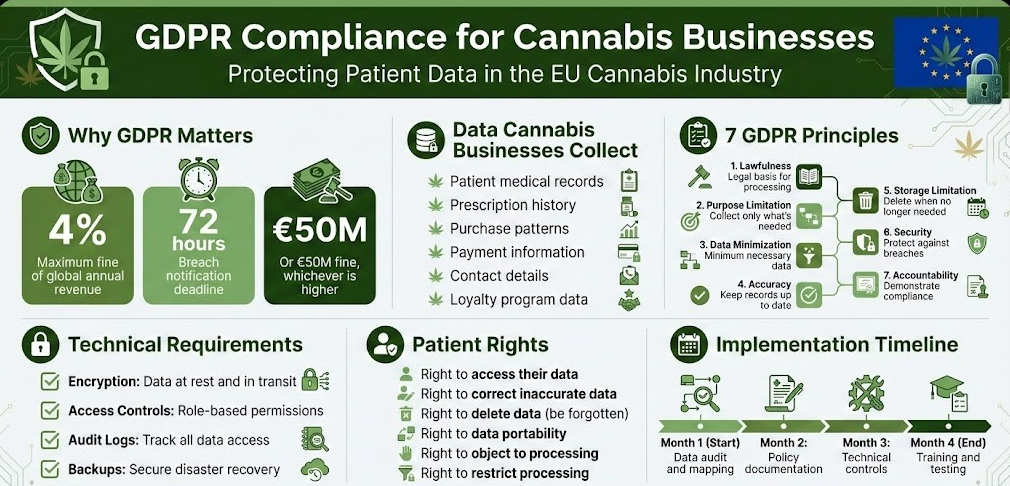
GDPR fines aren’t theoretical. By January 2025, cumulative GDPR penalties exceeded €5.88 billion. The maximum fine structure is designed to hurt:
- Up to €20 million, or
- 4% of total worldwide annual turnover (whichever is higher)
For a cannabis operation generating €10 million annually, that’s a potential €400,000 penalty for serious violations. For larger operators with cross-border presence, the exposure scales dramatically.
The enforcement trend is clear: regulators are moving beyond Big Tech. In 2024, authorities increasingly targeted healthcare, financial services, and retail sectors. Cannabis sits at the intersection of all three risk profiles.
Cannabis Businesses Handle Special Category Data
Under Article 9 of the GDPR, “data concerning health” receives the highest level of protection. This isn’t limited to medical records. It includes:
- Purchase histories that reveal health conditions
- Prescription information for medical cannabis patients
- Consultation notes from in-store pharmacists or budtenders
- Delivery addresses for medical products
- Payment records linked to health purchases
When a customer buys CBD oil for anxiety or THC products for chronic pain management, you’re processing health data—whether you realize it or not.
Regulatory Scrutiny Is Higher Than Other Industries
Cannabis businesses operate under a microscope. National drug enforcement agencies, financial regulators, and public health authorities already monitor the industry closely. Data protection authorities recognize that cannabis customers may face:
- Social stigma if their purchases become public
- Employment consequences in certain sectors
- Insurance implications for health and life coverage
- Legal exposure in jurisdictions with stricter laws
This heightened sensitivity means regulators are less likely to accept “we didn’t know” as an excuse. The reputational and legal exposure for your customers compounds your compliance obligations.
Section 1: What GDPR Means for Cannabis Operations
GDPR applies to any organization that processes personal data of individuals located in the European Economic Area (EEA), regardless of where the business is headquartered. If you serve EU customers—whether from a storefront in Amsterdam, an online pharmacy in Germany, or a cultivation facility shipping to distributors across Europe—you’re subject to these rules.
Patient and Customer Data You’re Collecting
Most dispensaries collect far more data than they realize. A comprehensive data audit typically reveals:
At Point of Sale:
- Full legal names and ID verification documents
- Dates of birth (age verification requirements)
- Physical addresses for delivery or registration
- Email addresses and phone numbers
- Purchase histories and product preferences
- Payment card data and transaction records
- Loyalty program participation and rewards balances
For Medical Cannabis Patients:
- Medical cannabis authorizations or prescriptions
- Prescribing physician information
- Qualifying medical conditions
- Dosage recommendations and consumption guidance
- Consultation notes from pharmacists or healthcare staff
- Renewal dates and prescription validity periods
Through Digital Channels:
- Website browsing behavior and session data
- IP addresses and device identifiers
- Account credentials and login histories
- Customer service chat logs and email correspondence
- Marketing preferences and opt-in records
Employee Data Obligations
Your GDPR responsibilities extend to your workforce. Cannabis businesses must protect:
- Employment contracts and HR records
- Background check results (particularly sensitive given industry regulations)
- Health and safety training records
- Timekeeping and payroll data
- Performance reviews and disciplinary records
- Security clearance documentation
Many cannabis licenses require operators to maintain detailed employee records for regulatory compliance. These retention requirements create tension with GDPR’s data minimization principle—a conflict we’ll address in Section 3.
Vendor and Supplier Data Processing
Your supply chain generates personal data obligations:
- Cultivation facility contact information
- Testing laboratory personnel data
- Distribution partner records
- Payment and banking contact details
- Compliance officer information for licensed partners
When you share customer data with vendors—for delivery services, payment processing, or marketing platforms—you become responsible for ensuring those vendors meet GDPR standards.
Marketing Data: Email Lists and Retargeting
Cannabis marketing faces unique restrictions, but compliant operators still build customer relationships through:
- Email newsletter subscribers
- SMS marketing lists
- Social media audience data (where platforms permit cannabis content)
- Retargeting pixels and advertising cookies
- Referral program participant information
Each of these data streams requires explicit legal basis, clear consent mechanisms, and documented processing purposes. The Swedish pharmacy cases demonstrate that improperly configured marketing technology can trigger multi-million euro fines.
Section 2: The 7 GDPR Principles Cannabis Businesses Must Follow
Article 5 of the GDPR establishes seven foundational principles. Violations of these principles attract the highest tier of administrative fines. Every cannabis operation must embed these requirements into daily practice.
1. Lawfulness, Fairness, and Transparency
You must have a valid legal basis for every data processing activity, treat individuals fairly, and be completely transparent about what you do with their information.
For cannabis dispensaries, this means:
- Clearly explaining why you collect each piece of data before collection occurs
- Publishing accessible, plain-language privacy notices
- Never processing data in ways customers wouldn’t reasonably expect
- Providing information about data processing in the customer’s language
- Avoiding deceptive practices like pre-ticked consent boxes
Legal bases available for cannabis operations:
- Consent (Article 6(1)(a)): The customer explicitly agrees to specific processing
- Contract performance (Article 6(1)(b)): Processing necessary to fulfill a purchase or service agreement
- Legal obligation (Article 6(1)(c)): Required by law (license reporting, tax records)
- Legitimate interests (Article 6(1)(f)): Business purposes that don’t override customer rights
For health data under Article 9, you’ll typically need explicit consent or must fall under the healthcare provision exception—which requires processing under the responsibility of a health professional bound by confidentiality obligations.
 cannabisrisk.diy
2. Purpose Limitation
Personal data must be collected for specified, explicit, and legitimate purposes—and not processed in ways incompatible with those original purposes.
Practical application:
If you collect email addresses to send order confirmations, you cannot automatically add those addresses to marketing lists without separate consent. If you gather medical information for prescription fulfillment, you cannot use that data for product development analytics without a new legal basis.
Document your processing purposes before collecting any data. When purposes change, reassess your legal basis and notify affected individuals.
3. Data Minimization
Collect only what you actually need. Many cannabis businesses over-collect data “just in case” it becomes useful—this violates GDPR and increases breach exposure.
Questions to audit your practices:
- Do you need full dates of birth, or just confirmation of legal age?
- Must you retain complete ID document copies, or just verification logs?
- Is detailed purchase history necessary, or can you anonymize older records?
- Do all staff need access to complete customer profiles?
The Estonian pharmacy breach demonstrated how retaining extensive purchase histories—including health-related products—created massive exposure when security failed. Less data means less risk.
4. Accuracy
Personal data must be accurate and kept up to date. You must take reasonable steps to ensure inaccurate data is erased or rectified without delay.
For cannabis operations:
- Implement processes for customers to review and correct their information
- Verify medical authorization validity and expiration dates
- Update customer contact preferences when bounced emails or failed deliveries occur
- Remove deceased individuals from active databases (with appropriate sensitivity)
Inaccurate data in cannabis contexts can cause real harm—imagine sending marketing about high-THC products to someone who switched to CBD-only for medical reasons, or continuing to process a prescription after the authorizing physician revoked it.
5. Storage Limitation
Keep personal data only as long as necessary for your processing purposes. This principle directly conflicts with some cannabis licensing requirements, creating compliance complexity we’ll address in Section 3.
Develop retention schedules covering:
- Transaction records (often 7-10 years for tax purposes)
- Medical authorizations (duration of validity plus regulatory requirements)
- Marketing consent records (as long as consent remains valid)
- Customer service logs (typically 2-3 years for dispute resolution)
- Employee records (varies by jurisdiction, often 7 years post-employment)
When retention periods expire, delete or anonymize the data. “Anonymization” under GDPR means truly irreversible—pseudonymized data still counts as personal data.
6. Integrity and Confidentiality
You must process data securely, protecting against unauthorized access, accidental loss, destruction, or damage. This principle encompasses your entire security program.
Key requirements:
- Encryption of data at rest and in transit
- Access controls limiting staff to minimum necessary data
- Regular security testing and vulnerability assessments
- Incident response procedures and breach detection capabilities
- Physical security for locations storing personal data
The Belgian hospital fined €200,000 after a ransomware attack, and the Polish company fined €336,000 for similar failures, demonstrate that “we were hacked” doesn’t excuse inadequate security. Regulators expect proactive protection, not reactive excuses.
7. Accountability
The controller—your organization—must demonstrate compliance. This isn’t about checking boxes; it’s about maintaining evidence that your program works.
Documentation requirements:
- Records of processing activities (Article 30)
- Data Protection Impact Assessments for high-risk processing
- Evidence of valid consent where relied upon
- Contracts with processors meeting Article 28 requirements
- Staff training records and policy acknowledgments
- Security measure documentation and testing results
If a regulator investigates, you must prove your compliance—the burden isn’t on them to prove violations.
Section 3: Cannabis-Specific GDPR Requirements
Beyond the general principles, cannabis businesses face unique compliance challenges stemming from the nature of their products and the regulatory environment.
Consent Management for Medical Cannabis Patients
Processing health data requires explicit consent under Article 9(2)(a)—or you must qualify for the healthcare provision exception under Article 9(2)(h).
Explicit consent for health data must be:
- Freely given: Patients cannot face negative consequences for refusing
- Specific: Tied to particular processing activities, not blanket authorization
- Informed: Patients understand exactly what they’re consenting to
- Unambiguous: Clear affirmative action, not pre-ticked boxes or silence
- Documented: You can prove consent was obtained and what it covered
- Withdrawable: Patients can revoke consent as easily as they gave it
Healthcare exception requirements:
If you operate under the healthcare provision exception, processing must occur under the responsibility of a health professional (pharmacist, physician) bound by professional secrecy obligations. This may apply to licensed medical cannabis pharmacies but likely doesn’t cover recreational dispensaries.
Practical implementation:
- Separate consent forms for different processing activities
- Granular options (order fulfillment vs. marketing vs. research participation)
- Clear explanation of how withdrawal affects services
- Timestamps and version control on consent records
- Regular consent refresh for ongoing processing
The Right to Be Forgotten vs. Regulatory Record-Keeping
Article 17 grants individuals the “right to erasure”—the ability to request deletion of their personal data. But cannabis licensing requirements often mandate years of record retention.
The conflict:
- A customer requests deletion of their purchase history
- Your cannabis license requires maintaining transaction records for 5-7 years
- GDPR says you must erase data when requested—unless legal obligations apply
Resolution:
Article 17(3)(b) exempts data from erasure when processing is necessary for compliance with legal obligations. However, you must:
- Delete any data not covered by legal retention requirements
- Restrict processing of retained data to compliance purposes only
- Clearly communicate to customers what you must retain and why
- Delete retained data immediately when retention periods expire
Example approach:
When a customer requests erasure, you might delete their email address, phone number, and marketing preferences while retaining pseudonymized transaction records for tax compliance. Document your legal basis for each retained data element.
Data Protection Impact Assessments (DPIAs)
Article 35 requires DPIAs for processing “likely to result in a high risk to the rights and freedoms of natural persons.” Cannabis operations likely trigger this requirement through:
- Large-scale processing of health data (medical cannabis programs)
- Systematic monitoring (surveillance cameras, employee tracking)
- Automated decision-making (algorithm-driven product recommendations)
- Combining datasets (merging purchase history with medical records)
- Processing data of vulnerable individuals (patients with serious conditions)
DPIA process:
- Describe the processing: What data, what purposes, what technology
- Assess necessity and proportionality: Is this the least invasive approach?
- Identify risks: What could go wrong for individuals?
- Mitigate risks: What controls reduce identified risks?
- Document and review: Maintain DPIA records and update when processing changes
Complete DPIAs before beginning high-risk processing. If residual risks remain high after mitigation, consult your supervisory authority before proceeding.
Data Protection Officer (DPO) Requirements
Under Article 37, you must appoint a DPO if:
- You are a public authority
- Your core activities require large-scale, regular, and systematic monitoring of individuals
- Your core activities involve large-scale processing of special category data (including health data)
For cannabis dispensaries:
Medical cannabis operations processing patient health data at scale almost certainly require a DPO. Recreational dispensaries may also qualify if customer tracking and profiling constitutes “systematic monitoring.”
DPO responsibilities:
- Informing and advising on GDPR obligations
- Monitoring compliance with data protection policies
- Advising on Data Protection Impact Assessments
- Serving as contact point for supervisory authorities
- Serving as contact point for individuals regarding their data
The DPO must report to the highest management level, cannot receive instructions regarding their tasks, and cannot be penalized for performing their duties. They can be an employee or external contractor, but must have expert knowledge of data protection law and practices.
Failing to appoint a required DPO can trigger fines up to €10 million or 2% of annual turnover.
Cross-Border Data Transfers
If you transfer personal data outside the European Economic Area—to cloud providers, payment processors, analytics platforms, or corporate headquarters in non-EU countries—Chapter V of GDPR applies.
Transfer mechanisms:
Adequacy decisions: The European Commission has determined certain countries provide adequate protection. You can transfer to these countries without additional safeguards. Current adequacy countries include the UK (extended through 2031), Canada, Japan, South Korea, and the United States (under the EU-US Data Privacy Framework for certified organizations).
Standard Contractual Clauses (SCCs): EU-approved contract templates that bind the data importer to GDPR-equivalent protections. Most common mechanism for transfers to non-adequate countries.
Binding Corporate Rules (BCRs): Internal policies approved by supervisory authorities for transfers within multinational corporate groups.
Derogations: Limited exceptions for specific situations (explicit consent, contract necessity) that don’t support regular, large-scale transfers.
The TikTok warning:
In 2025, Ireland’s Data Protection Commission fined TikTok €530 million for transferring European user data to China without adequate protections. The investigation found TikTok failed to properly assess Chinese surveillance laws and couldn’t demonstrate equivalent protection. Cannabis businesses using Chinese-owned technology or transferring data to countries without adequacy decisions must conduct similar assessments—and document their conclusions.
Practical steps:
- Map all data flows outside the EEA
- Verify adequacy status or implement appropriate safeguards
- Conduct Transfer Impact Assessments for non-adequate countries
- Include GDPR-compliant data protection clauses in all vendor contracts
- Monitor for changes in adequacy decisions and transfer mechanism validity
Section 4: Technical Security Requirements
The “integrity and confidentiality” principle translates into specific technical and organizational measures. GDPR doesn’t prescribe exact technologies, but Article 32 requires security “appropriate to the risk”—and health data processing demands robust protection.
Encryption Requirements
Data at rest:
- Encrypt customer databases, backup files, and archived records
- Use full-disk encryption on employee devices (laptops, tablets, phones)
- Protect removable media (USB drives, external hard drives)
- Implement encryption key management procedures
Data in transit:
- TLS 1.2 or higher for all web traffic
- Encrypted email for communications containing personal data
- VPN connections for remote access to internal systems
- Secure file transfer protocols for vendor data exchange
Practical consideration:
The 2024 Swedish pharmacy fines stemmed partly from inadequate security measures that allowed Meta Pixels to transmit customer data without proper protection. Even marketing technology must meet encryption standards.
Access Controls for Patient Records
Principle of least privilege:
- Staff access only the data necessary for their specific role
- Budtenders see current transaction data, not complete purchase histories
- Pharmacists access medical records; retail staff do not
- Marketing teams see aggregate analytics, not individual profiles
Technical implementation:
- Role-based access control (RBAC) systems
- Unique user credentials (no shared logins)
- Multi-factor authentication for sensitive system access
- Automatic session timeouts for inactive users
- Access logging and regular access reviews
Physical access:
- Secure areas for systems storing personal data
- Visitor logs and escort requirements
- Clean desk policies in customer-facing areas
- Secure disposal of paper records containing personal data
Pseudonymization Techniques
Pseudonymization—replacing identifying information with artificial identifiers—reduces risk without eliminating data utility. Under GDPR, pseudonymized data remains personal data, but it’s recognized as a security measure that can reduce breach impact.
Approaches for cannabis operations:
- Replace customer names with account numbers in analytics systems
- Separate identifying information from purchase histories
- Use hashed identifiers for loyalty program tracking
- Tokenize payment card data through certified processors
Key requirement:
Keep the “key” that links pseudonymized data to real identities under strict separate access controls. If the key is compromised alongside the pseudonymized data, you’ve achieved nothing.
Backup and Disaster Recovery
Regulators expect resilience. The Croatian hospital fined €190,000 for losing radiological images—with no backup—demonstrates that data loss violates GDPR even without external breach.
Minimum requirements:
- Regular automated backups of all systems containing personal data
- Encrypted backup storage, ideally at geographically separate locations
- Tested restoration procedures (untested backups provide false confidence)
- Retention policies aligned with GDPR storage limitation principles
- Secure destruction of backup media when retention periods expire
Business continuity planning:
- Documented recovery time objectives for critical systems
- Alternate processing arrangements for extended outages
- Communication plans for notifying customers of service disruptions
- Regular testing of disaster recovery procedures
Vendor Security Due Diligence
Article 28 requires written contracts with processors that bind them to GDPR obligations. But contracts alone aren’t enough—you must verify vendor security.
Due diligence elements:
- Security certifications (ISO 27001, SOC 2 Type II)
- Data processing agreement covering all Article 28 requirements
- Subprocessor lists and approval requirements
- Audit rights and evidence of regular security assessments
- Breach notification commitments (immediate notification to you as controller)
- Data deletion or return upon contract termination
Ongoing monitoring:
- Annual security questionnaires or evidence review
- Notification requirements for material security changes
- Regular verification of subprocessor arrangements
- Incident response coordination testing
The Vodafone Germany €45 million fine for inadequate subprocessor oversight shows regulators hold controllers responsible for their entire processing chain.
Section 5: The 72-Hour Breach Notification Rule
Article 33 imposes one of GDPR’s most demanding requirements: breach notification within 72 hours. For cannabis businesses handling sensitive health data, breaches carry amplified risks—and notification obligations.
What Constitutes a Breach
A personal data breach means any security incident leading to accidental or unlawful:
- Destruction: Data is deleted and cannot be recovered
- Loss: Data becomes unavailable (ransomware, hardware failure)
- Alteration: Data is changed without authorization
- Unauthorized disclosure: Data is shared with unauthorized recipients
- Unauthorized access: Someone gains access they shouldn’t have
Cannabis-specific breach scenarios:
- Ransomware encrypting customer database and demanding payment
- Employee accessing patient records without business justification
- Marketing email sent with recipients visible in CC instead of BCC
- Laptop containing customer data stolen from employee vehicle
- Vendor security incident exposing data you shared with them
- Misconfigured cloud storage making purchase records publicly accessible
- Paper prescription records improperly disposed of without shredding
Who to Notify
Supervisory authority notification (Article 33):
Required unless the breach is “unlikely to result in a risk to the rights and freedoms of natural persons.” Given the sensitivity of cannabis-related health data, most breaches will require notification.
Notify your lead supervisory authority—typically the data protection authority in the EU member state where your main establishment is located. For operations across multiple member states, the “one-stop-shop” mechanism means you deal primarily with one authority.
Individual notification (Article 34):
Required when the breach is “likely to result in a high risk to the rights and freedoms of natural persons.” Cannabis data breaches often meet this threshold because:
- Health data exposure can cause discrimination and stigma
- Purchase patterns may reveal conditions individuals haven’t disclosed to employers or insurers
- Medical cannabis use may carry professional consequences in some sectors
Exception: Individual notification isn’t required if you’ve implemented measures (like encryption) that render data unintelligible to unauthorized recipients, or if subsequent measures have eliminated the high risk.
Documentation Requirements
Even if a breach doesn’t require notification, Article 33(5) mandates documentation of:
- The facts relating to the breach
- Its effects
- Remedial action taken
This documentation must enable the supervisory authority to verify your compliance. Maintain breach logs indefinitely—regulators may request them during investigations or audits.
Breach Notification Content
Supervisory authority notification must include:
Nature of the breach, including:
-
Categories of data affected
-
Approximate number of individuals affected
-
Categories and approximate number of records affected
-
Name and contact details of your Data Protection Officer or other contact point
-
Likely consequences of the breach
-
Measures taken or proposed to address the breach, including mitigation of adverse effects
If you can’t provide complete information within 72 hours, you may provide it in phases “without undue further delay.” But notify promptly with available information rather than waiting for a complete picture.
Individual notification must:
- Use clear, plain language
- Describe the nature of the breach
- Provide DPO or contact point information
- Describe likely consequences
- Describe measures taken or proposed
- Provide specific guidance on steps individuals can take to protect themselves
Incident Response Essentials
Preparation (before any breach occurs):
- Documented incident response plan with clear roles and responsibilities
- Pre-drafted notification templates for supervisory authorities and individuals
- Contact lists for key personnel, legal counsel, and communication resources
- Relationships with forensic investigation providers
- Cyber insurance with appropriate coverage limits
Response phases:
Detection and initial assessment (hours 0-4)
- Confirm a security incident has occurred
- Initial scope determination
- Preservation of evidence
- Activation of response team
Investigation and containment (hours 4-48)
- Determine what data was affected
- Stop ongoing unauthorized access
- Assess notification obligations
- Engage forensic resources if needed
Notification decision (hours 48-72)
- Document rationale for notification or non-notification
- Prepare notification content
- Submit to supervisory authority before 72-hour deadline
- Determine individual notification requirements
Recovery and remediation (ongoing)
- Eliminate vulnerabilities that enabled the breach
- Restore affected systems
- Monitor for ongoing threats
- Prepare for regulatory inquiries
Section 6: Common GDPR Violations in Cannabis
Learning from others’ mistakes is cheaper than making your own. These violation patterns appear frequently in cannabis operations—and across the healthcare and retail sectors from which regulators draw enforcement precedent.
1. Using Track-and-Trace Systems Without EU Compliance
Cannabis-specific platforms like Metrc (Marijuana Enforcement Tracking Reporting Compliance) were designed for US regulatory environments. Implementing these systems in the EU without modification creates GDPR risks:
- Data transfer issues: Many platforms store data on US servers without adequate transfer mechanisms
- Retention conflicts: US regulatory retention requirements may not align with GDPR storage limitation
- Access controls: Systems designed for US regulatory access may not support EU-appropriate limitations
- Processor relationships: Contracts may not include required Article 28 terms
Solution: Audit any US-origin cannabis software for GDPR compatibility. Require vendors to demonstrate EU data residency options, appropriate contract terms, and compliant data transfer mechanisms.
2. Marketing Without Proper Consent
The ePrivacy Directive (soon to be replaced by the ePrivacy Regulation) adds requirements beyond GDPR for electronic marketing. Cannabis businesses frequently violate:
- Email marketing: Sending promotional content without explicit opt-in consent
- SMS marketing: Text messages require consent under most EU member state laws
- Retargeting pixels: Installing tracking cookies without valid consent
- Third-party data: Purchasing marketing lists without verifying consent chain
The Swedish pharmacy paid €3.2 million because Meta Pixels transmitted customer data to Facebook without proper consent or security configuration. The French CNIL fined Google and Facebook €210 million for making cookie rejection more difficult than acceptance.
Solution: Implement a consent management platform that:
- Obtains affirmative consent before setting non-essential cookies
- Provides equally easy acceptance and rejection options
- Logs consent with timestamp, version, and scope
- Respects consent withdrawal immediately
3. Sharing Data with Third Parties
Cannabis businesses routinely share customer data with:
- Delivery services: Addresses, names, and product orders
- Payment processors: Transaction details and customer identifiers
- POS vendors: Complete transaction and customer databases
- Marketing platforms: Customer lists and behavioral data
- Testing laboratories: Product data linked to customer orders
Each sharing arrangement requires:
- Valid legal basis for the disclosure
- Data processing agreement if sharing with a processor
- Notification to customers in your privacy notice
- Due diligence on the recipient’s security practices
The Italian fine against a medical device company (€300,000) for exposing customer email addresses to other recipients demonstrates that even “minor” disclosures trigger enforcement.
4. Inadequate Employee Access Controls
Internal data misuse constitutes a data breach. Common failures include:
- Shared login credentials making individual access untrackable
- Excessive access allowing all staff to view all customer records
- Missing audit logs preventing detection of unauthorized access
- Terminated employee access remaining active after employment ends
Solution: Implement role-based access controls with unique credentials, require multi-factor authentication, log all access to personal data, and integrate access revocation into employee offboarding procedures.
5. Case Study: Healthcare Sector Precedent
Dedalus Biologie (France): €1.5 million fine
A software vendor for medical laboratories suffered a breach exposing 500,000 patient records, including HIV status, cancer diagnoses, genetic data, and pregnancy information.
The CNIL found:
- No specific procedure for data migration operations
- No encryption of personal data on the affected server
- No automatic deletion of data after migration
- No authentication required from the internet to access the server
- Shared user accounts among multiple employees
Lesson for cannabis businesses: Technical and organizational measures aren’t optional. Regulators will examine your security practices in detail after any incident—and inadequate protection of health data attracts significant penalties.
Section 7: Implementation Roadmap
Building GDPR compliance isn’t a one-time project—it’s an ongoing program. This four-month implementation roadmap establishes foundational compliance, followed by continuous improvement.
Month 1: Data Audit and Mapping
Week 1-2: Data discovery
- Inventory all systems, databases, and applications containing personal data
- Interview department heads to identify informal data collections (spreadsheets, paper files)
- Document data flows between internal systems and external vendors
- Identify cross-border data transfers
Week 3-4: Data mapping
-
Create records of processing activities (Article 30 requirement) Document for each processing activity:
-
Categories of personal data
-
Categories of data subjects
-
Processing purposes and legal bases
-
Data retention periods
-
Recipients and transfers
-
Security measures
-
Identify high-risk processing requiring DPIAs
-
Assess current data against minimization requirements
Deliverables:
- Complete data inventory
- Records of processing activities
- Gap analysis identifying compliance deficiencies
- DPIA requirement assessment
Month 2: Policy Documentation
Week 5-6: Core policies
- Privacy notice (customer-facing)
- Employee privacy policy
- Data protection policy (internal governance)
- Data retention policy with specific schedules
- Breach notification procedures
Week 7-8: Operational procedures
- Data subject access request handling
- Consent management procedures
- Data deletion and anonymization procedures
- Vendor due diligence requirements
- Employee access control procedures
Deliverables:
- Published privacy notice
- Complete policy suite
- Documented operational procedures
- Consent management implementation plan
Month 3: Technical Controls
Week 9-10: Security implementation
- Encryption deployment (at rest and in transit)
- Access control system configuration
- Audit logging activation
- Multi-factor authentication rollout
- Backup verification and testing
Week 11-12: Vendor compliance
- Data processing agreement execution with all processors
- Security questionnaire collection and review
- Subprocessor identification and documentation
- Contract amendments for non-compliant agreements
Deliverables:
- Technical security measures operational
- Executed DPAs with all processors
- Vendor security evidence on file
- Technical security documentation
Month 4: Training and Testing
Week 13-14: Training program
- All-staff GDPR awareness training
- Role-specific training for data handlers
- Incident response training for response team
- DPO or privacy lead advanced training
Week 15-16: Testing and validation
- Data subject request handling drill
- Breach simulation exercise
- Access control audit
- Policy comprehension verification
Deliverables:
- Training completion records
- Test results and improvement actions
- Compliance readiness assessment
- Ongoing monitoring schedule
Ongoing: Compliance Monitoring
Monthly:
- Review access control appropriateness
- Process and document any data subject requests
- Monitor for vendor security incidents
- Review and update consent records
Quarterly:
- Update records of processing activities
- Assess new processing activities for DPIA requirements
- Review and refresh employee training
- Test incident response procedures
Annually:
- Comprehensive compliance audit
- Privacy notice and policy updates
- Vendor re-assessment
- Retention schedule enforcement
- DPIA reviews for high-risk processing
Section 8: GDPR Compliance Checklist
This 50-point checklist covers essential GDPR requirements for cannabis operations. Use it to assess your current compliance status and track implementation progress.
Governance and Accountability (10 points)
- ☐ Designated data protection lead or DPO (if required)
- ☐ Data protection responsibilities assigned across organization
- ☐ Board or senior management oversight of data protection
- ☐ Budget allocated for data protection activities
- ☐ Records of processing activities maintained (Article 30)
- ☐ Data protection policies approved and published
- ☐ Privacy by design considered for new projects
- ☐ Regular compliance reviews scheduled
- ☐ Data protection integrated into risk management
- ☐ Accountability documentation maintained for regulator inquiries
Lawful Processing (10 points)
- ☐ Legal basis identified and documented for each processing activity
- ☐ Special category data processing justified under Article 9
- ☐ Consent mechanisms meet GDPR requirements where relied upon
- ☐ Consent records maintained with timestamps and scope
- ☐ Legitimate interest assessments documented where applicable
- ☐ Processing purpose limitation enforced
- ☐ Data minimization implemented across systems
- ☐ Accuracy verification procedures in place
- ☐ Retention schedules defined and enforced
- ☐ Lawful basis regularly reviewed for ongoing processing
Transparency and Individual Rights (10 points)
- ☐ Privacy notice published and accessible
- ☐ Privacy information provided at data collection points
- ☐ Data subject access request procedures documented
- ☐ Processes to respond to access requests within one month
- ☐ Rectification request handling procedures
- ☐ Erasure request handling (balancing against legal retention)
- ☐ Data portability capability for relevant data
- ☐ Objection and restriction handling procedures
- ☐ Automated decision-making transparency and challenge mechanisms
- ☐ Staff trained on individual rights handling
Security and Breach Management (10 points)
- ☐ Encryption implemented for data at rest and in transit
- ☐ Access controls based on role and necessity
- ☐ Multi-factor authentication for sensitive system access
- ☐ Audit logging enabled for personal data access
- ☐ Regular security testing conducted
- ☐ Backup procedures tested and documented
- ☐ Incident response plan documented
- ☐ Breach detection capabilities implemented
- ☐ 72-hour breach notification procedures ready
- ☐ Breach documentation and lessons learned processes
Vendors and International Transfers (10 points)
- ☐ All processors identified and documented
- ☐ Data processing agreements executed with all processors
- ☐ Processor security due diligence completed
- ☐ Subprocessor arrangements documented and approved
- ☐ International transfers mapped
- ☐ Transfer mechanisms in place for non-adequate countries
- ☐ Transfer impact assessments conducted where required
- ☐ Standard contractual clauses implemented where needed
- ☐ Ongoing processor monitoring procedures
- ☐ Processor contract termination procedures (data return/deletion)
Conclusion: GDPR as Competitive Advantage
Compliance isn’t just about avoiding fines—though avoiding a €20 million penalty is certainly worthwhile. GDPR compliance creates genuine business advantages in the maturing European cannabis market.
Compliant Businesses Win Enterprise Contracts
As institutional investors, pharmaceutical partners, and healthcare systems enter the cannabis sector, they demand supply chain compliance. Organizations conducting due diligence will verify:
- Documented data protection programs
- DPO appointments where required
- Breach notification capabilities
- Processor oversight practices
- International transfer compliance
Companies without demonstrable GDPR compliance will lose opportunities to those who can satisfy these requirements.
Consumer Trust Drives Loyalty
Cannabis customers—particularly medical patients—are entrusting you with sensitive information about their health, their consumption, and their personal choices. Demonstrating respect for that trust through robust data protection builds loyalty that competitors cannot easily replicate.
Privacy-conscious customers increasingly choose businesses that respect their data. A clear, honest privacy notice and responsive rights handling differentiate your operation in a crowded market.
Operational Excellence Follows
The discipline required for GDPR compliance—data mapping, access controls, vendor management, incident response—improves overall operational quality. Organizations that know what data they have, where it flows, and who accesses it run more efficiently and securely than those operating blind.
The Path Forward
GDPR compliance is achievable for cannabis operations of any size. The requirements are demanding but logical: know what data you have, have good reasons for processing it, protect it appropriately, respect individual rights, and be prepared when things go wrong.
Start with the data audit. Build your documentation. Implement technical controls. Train your people. Test your procedures. And recognize that compliance is never finished—it’s an ongoing commitment to responsible data stewardship.
The European cannabis industry is building something new. Build it right.
This guide provides general information about GDPR compliance for cannabis businesses. It does not constitute legal advice. Consult qualified legal counsel in relevant EU jurisdictions for advice specific to your operations.
About CISO Marketplace
CISO Marketplace provides cybersecurity and compliance resources for businesses navigating complex regulatory environments. Our team has completed over 400 security assessments across healthcare, retail, and regulated industries.
*Need help implementing GDPR compliance for your cannabis operation? *
[CISO Marketplace Micro Tool