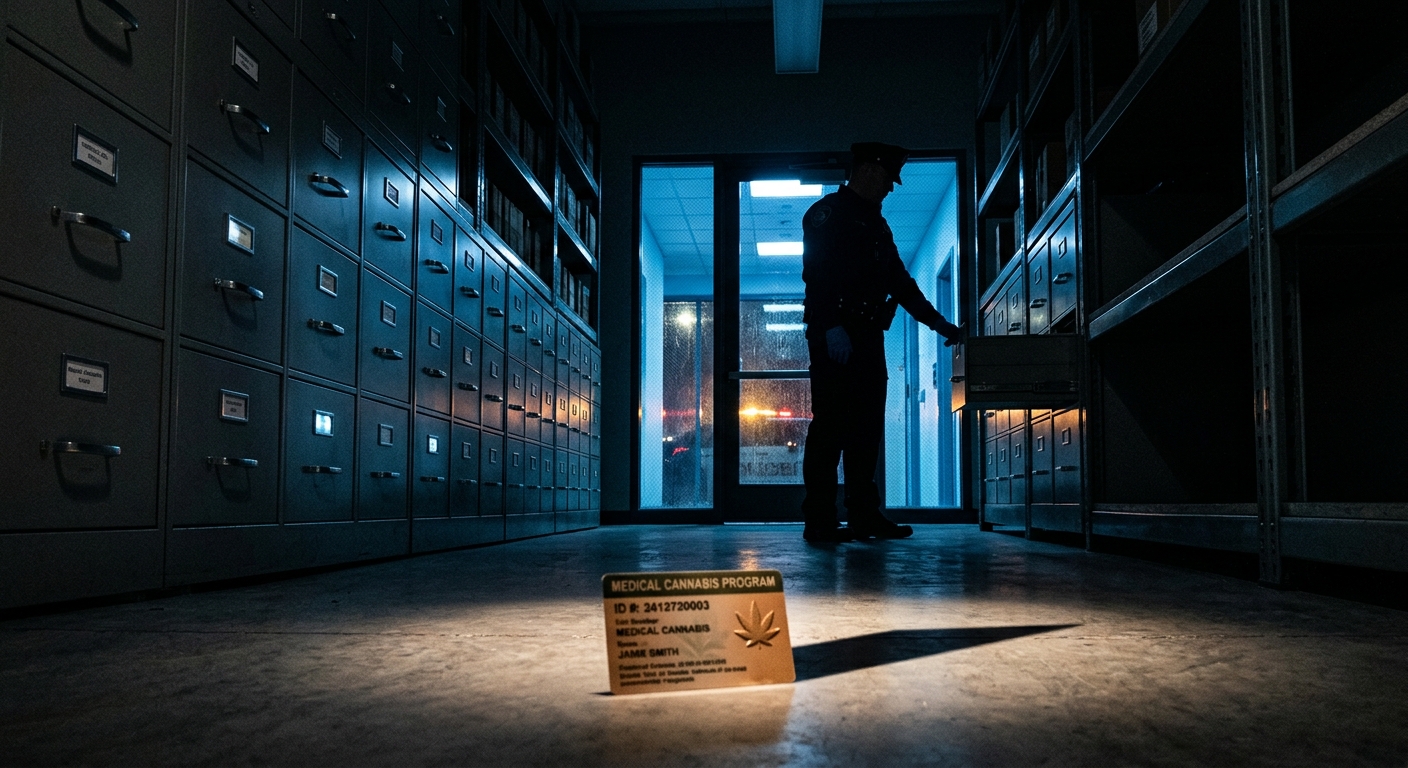
Utah’s Department of Commerce, Division of Professional Licensing (DOPL) announced this week that the state’s Controlled Substance Database — Utah’s prescription drug monitoring program — now includes a medical cannabis module. Authorized health care providers and controlled substance dispensers can look up a registered patient and see their actual dispensing history: purchase dates, quantities, product types, and the dispensing facility.
The data comes from the Electronic Verification System, Utah’s cannabis seed-to-sale and patient-verification platform. Records generally appear the day after a purchase.
The functional change is smaller than it sounds and larger than it looks. Utah’s CSD could already indicate that a person was a registered medical cannabis patient. What is new is the detail: not “this person participates in the program,” but “this person bought 3.5 grams of flower at this dispensary on this date, and here are the eleven visits before that.”
The module took effect June 24, 2026. The public announcement came in late August. That two-month gap is the part of this story operators need to think hardest about.
What Actually Changed
Before: a provider querying the CSD saw a flag. The patient is in the program. Useful for avoiding dangerous interactions, roughly equivalent to knowing someone takes an over-the-counter supplement.
After: a provider querying the CSD sees a longitudinal purchase record with product-level granularity, refreshed daily, sitting in the same interface as the patient’s opioid and benzodiazepine dispensing history.
That last detail is the one with consequences. A PDMP is not a neutral archive. It is a clinical decision-support tool built for a specific purpose — spotting patterns that suggest misuse — and it is consulted at moments of consequence: before a prescription is written, before a referral, before a pain contract is signed or terminated.
Cannabis dispensing records placed in that interface will be read through that lens, whether or not anyone intended it. A patient with a high-frequency cannabis dispensing history sitting next to their opioid record is going to have conversations that a patient without one does not.
Utah’s program has real integration arguments in its favor. Cannabis interacts with other medications. Providers making prescribing decisions genuinely benefit from a complete picture, and patients frequently do not volunteer cannabis use. This is not a bad-faith surveillance program, and treating it as one gets the analysis wrong.
But “the purpose is legitimate” and “the privacy design is sound” are separate questions, and this deserves scrutiny on the second one.
The Three Questions Every Data-Sharing Arrangement Has to Answer
We used the CDC’s proposed NHIS cannabis questions as a model of well-designed collection. The same three tests apply here.
1. What is the purpose limitation?
A PDMP’s stated purpose is clinical safety and diversion detection. Both are real. The question is whether cannabis dispensing data is walled off from anything else the CSD is used for. Utah’s CSD, like most PDMPs, has an access framework covering licensing investigations and, under defined conditions, law enforcement. A patient needs to know precisely where the cannabis module sits inside that framework — and “it follows the existing CSD rules” is an answer that requires the patient to already understand the existing CSD rules.
2. Who can see it?
“Authorized health care providers and controlled substance dispensers” is a broad category. In practice it includes prescribers a patient has never met — an urgent care physician, an emergency department, a pharmacist filling an unrelated prescription. PDMP access is generally not limited to a treating relationship the patient has consented to.
For a patient managing chronic pain who uses cannabis specifically to reduce opioid intake, that visibility can be helpful or it can be the reason a prescription gets denied. Patients deserve to know which world they are in before they make a purchase.
3. Was there notice?
This is the weak point. The module went live June 24. The public announcement landed in late August. In between, every medical cannabis purchase in Utah was written into a provider-accessible clinical database, by patients who had no reason to know the flag they had consented to had become a ledger.
Nobody violated anything. The CSD’s authority is statutory, the EVS already held the data, and the state was not required to run a press campaign. But the practical outcome is that patients made disclosure decisions without knowing the disclosure had widened. That is exactly the HIPAA gap this industry keeps rediscovering: patient health data governed by state administrative rules rather than a framework built around patient notice and consent.
Why This Matters Outside Utah
Utah is small, tightly regulated, and unusual — the EVS gives the state a level of transaction-level visibility most markets do not have. That makes it a preview rather than an outlier.
Every state running a medical program already collects the underlying data. Seed-to-sale systems record product, quantity, date, and location. Patient registries record identity. Connecting the two and exposing the result to clinicians is a small technical step and an enormous privacy step, and it requires no new legislation in most states — just an integration decision between two agencies that already hold the pieces.
Expect more of these. The clinical argument is genuinely persuasive, the data already exists, and the integration cost is low. States that have resisted PDMP integration because cannabis is not a prescription drug will find that reasoning harder to hold as Schedule III reshapes how cannabis is framed clinically.
The consequence for the industry is direct. A dispensary transaction record is becoming a medical record in more places, more of the time, with fewer of the protections that phrase normally implies.
What Operators Should Do
1. Know exactly what your state shares, and when it started.
Not what the rules said when you got licensed — what the integration does today. Ask your regulator directly: does dispensing data flow to the PDMP, at what granularity, who can query it, and when did that begin? Put the answer in writing and date it. Utah operators should be asking why they learned about a June change in August.
2. Tell patients before they ask.
The single highest-value thing a dispensary can do here costs nothing: a plain-language notice at the point of sale explaining where the purchase record goes. Something like:
Your medical cannabis purchases are reported to the state’s Electronic Verification System. As of June 2026, authorized health care providers can view your dispensing history — dates, amounts, and product types — through the Controlled Substance Database. This is the same system that shows providers your prescription history.
That is not a warning against buying. It is the information a patient needs to have an informed conversation with their own doctor, and it converts a future betrayal into a present choice. Patients who find out from a physician who did not have to ask them will remember that the dispensary knew and said nothing.
3. Train staff on the actual answer.
“Can my doctor see this?” is now a front-of-house question in Utah and will be elsewhere. The wrong answers are “no” and “I don’t know.” Give budtenders a two-sentence script and a card to hand over. Get it reviewed by counsel so it is accurate to your state, and update it whenever the integration changes.
4. Do not let your own data sprawl in sympathy.
There is a bad instinct that follows announcements like this: the state already sees everything, so what does our retention policy matter? It matters more, not less. State disclosure is compelled and bounded by rules. Your own retention is voluntary, and every extra month of purchase history in your POS is a month of a now-demonstrably-sensitive medical record sitting in a system with a breach history. Report what you must. Keep locally only what you actually need. Segment patient data from marketing systems and enforce it with access control, not policy documents.
5. Comment where you can, and ask for notice as the fix.
The right ask here is not “undo the integration.” It is patient-facing notice: a clear statement in the registry portal and at the point of enrollment about what the CSD shows and who may look. That is a cheap change with real value, and it is a request regulators grant far more often than they grant rollbacks.
Bottom Line
Utah did not do anything unusual. It connected two databases the state already had, for a clinical reason that holds up, under existing authority — and every medical cannabis purchase in the state became visible to any authorized provider running a routine PDMP check, two months before anyone told the patients.
The integration is defensible. The notice gap is not, and it is the part every other state is about to copy along with the rest.
Operators cannot fix the notice gap at the state level on their own. They can close it at the counter, for their own patients, this week — and the ones who do will be the ones patients still trust when the next integration lands.
Utah’s Division of Professional Licensing announced the Controlled Substance Database medical cannabis search function in late August 2026; the module took effect June 24, 2026 and draws dispensing data from the state’s Electronic Verification System. Reporting via The Marijuana Herald. Program administration is scheduled to transition from the Department of Health and Human Services to the Department of Agriculture and Food by January 1, 2027.