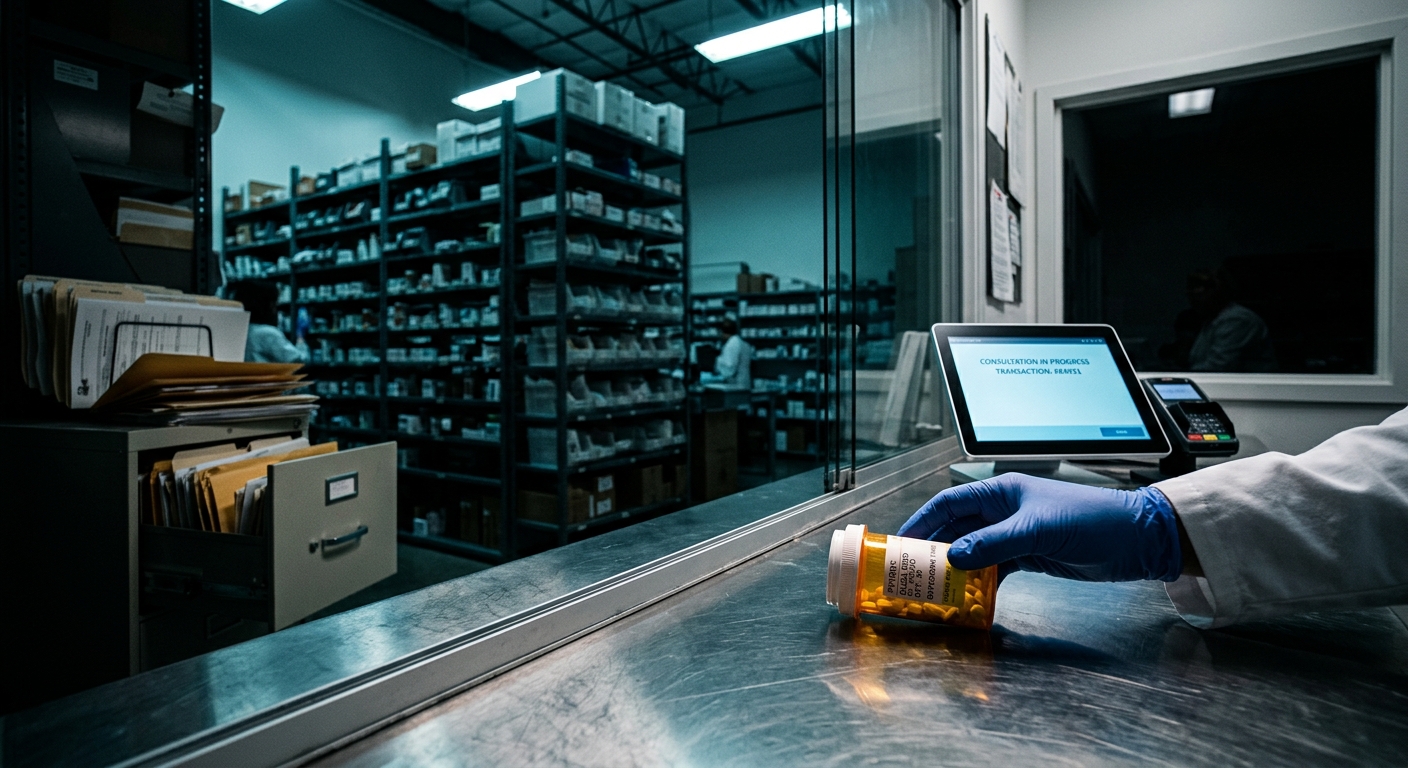
Illinois has posted the application that adult-use dispensaries will use, beginning September 10, 2026, to seek medical dispensing authority. Holders of an active Section 15-36 adult-use dispensing license can apply for a 15-37 license, pay a $5,000 nonrefundable fee, and — once approved — serve registered patients at the medical tax rate.
The application must be submitted at least 30 days before the intended implementation date. IDFPR has been explicit that posting an application is not the same as approval, and that patients should verify a location’s actual authorization rather than assume it.
The operational requirements are short enough to read in a sitting: patient priority through designated lines and registers, dedicated consultation areas for patient education and counseling, protection of patient information, and point-of-sale configuration that correctly exempts medical purchases from adult-use excise tax.
Four bullets. Three of them are data problems.
What Changes the Moment You Take Your First Patient
An adult-use dispensary handles identity data. You scan an ID to confirm someone is 21, you ring a sale, and — if the customer joins your loyalty program — you keep a purchase history tied to a name.
A medical dispensary handles something categorically different. You verify a registry card, which means you are confirming a state-issued credential whose existence proves the holder has a qualifying medical condition. You record that verification. Your POS ties a diagnosis-implying credential to a product-level purchase history, and it does so for every visit.
Under Illinois law and the roughly twenty state privacy regimes that now treat health-adjacent data as sensitive, that record is health information. Illinois’s own expanded qualifying-condition list makes the inference sharper, not softer: a narrower condition list means the card itself carries more diagnostic signal.
The day your 15-37 approval lands, a system built for age verification starts producing medical records. Nothing in the application forces you to notice that.
The Four Requirements, Read as Security Controls
Patient priority — designated lines and registers.
Read this as an access-control requirement, not a queueing one. A designated medical register is the natural place to enforce a separate POS role: staff who process medical transactions see registry status and consultation notes; staff on adult-use registers do not. If you run one flat POS role across every terminal, patient-visible fields are exposed to every employee on every shift, and your access log cannot distinguish a legitimate patient lookup from browsing.
Build the register separation the rule requires, then put a permission boundary on it. The physical requirement gives you a free excuse to do the thing you should be doing anyway.
Consultation areas — dedicated space for education and counseling.
A private room where patients discuss conditions and dosing generates two risks operators consistently miss.
First, whatever gets written down in there is a clinical note. If a staff member records “patient reports chemo nausea, recommended low-dose edible,” that is health information in a system almost certainly not designed to hold it — sometimes a POS notes field, sometimes a shared spreadsheet, occasionally a group chat. Decide before opening whether consultations get documented at all. If they do, decide exactly where, who can read it, and how long it survives. “Wherever the budtender put it” is the wrong answer and a plaintiff’s favorite one.
Second, consultation rooms are usually camera-covered because state security rules demand coverage of the licensed premises. Cannabis surveillance footage is retained for months and is producible to regulators. A camera with audio pointed at a room where patients describe medical conditions creates a retained health-data record in a system nobody thinks of as a health-data system. Check whether your consultation-area cameras capture audio, confirm what your state actually requires there, and document the decision.
Privacy controls — protection of patient information.
This is the vaguest requirement and the one that will be cited against you. Vague standards get interpreted after an incident, against the operator, by reference to what a reasonable operator would have done.
Make it concrete before anyone else does. Written policy on who accesses patient records and why. Role-based POS permissions with logging. Retention schedule with actual deletion. Patient data segmented from marketing systems — a medical purchase history must not flow into your promotional segmentation, which is where privacy claims most often start. Vendor agreements covering anyone who touches the data. Staff training with sign-off. Incident response naming who calls whom.
That is a defensible answer to “what privacy controls do you have.” A folder full of PDFs is not.
POS tax configuration.
The tax rule is the tell. To apply the medical rate you must record, per transaction, that the buyer was a verified patient — a durable, auditable health-status flag in your sales database, retained as long as your tax records are. This is not optional and it should not be minimized. It should be protected: encrypted at rest, access-logged, and excluded from every analytics or reporting export that does not specifically need it.
Most operators will configure this in an afternoon with their POS vendor and never think about it again. It deserves more thought than the consultation room.
Ask Your POS Vendor These Five Questions First
You have until September 10 to apply and thirty days of lead time after that. Use it on your vendor.
- Does your platform support role-based permissions that restrict patient fields to specific users or registers? If the answer is “everyone with a login sees everything,” you cannot satisfy the patient-priority separation in any meaningful way.
- Is patient registry status logged on access, and can I export that log? You need to be able to show who looked at what.
- Can patient data be excluded from marketing exports and third-party integrations by default? Default matters. Opt-out configurations get missed.
- What is the retention default for patient records, and can I set a shorter one? Then set it.
- Will you sign a data protection agreement covering patient health information specifically? Refusal or vagueness is your answer about how they classify the data internally.
Illinois operators already learned this year that regulatory expansion widens the attack surface faster than security programs adapt. SB 3222 added drive-thrus, extended hours, and telehealth certification pathways. Section 15-37 adds patients. Each one arrived as a business opportunity with an unlabeled data obligation stapled to the back.
The 30-Day Window Is the Whole Opportunity
The lead-time requirement is the most useful thing in this application. You must submit at least thirty days before you intend to start serving patients, which means you have a hard-dated runway between decision and first transaction.
Spend it like this:
- Days 1–7: POS vendor conversation. Get the five answers in writing. Determine what your platform can and cannot enforce.
- Days 8–14: Configure roles, permissions, logging, retention, and the marketing-export exclusion. Verify the tax flag is set and protected.
- Days 15–21: Write the consultation documentation policy and decide the camera-audio question. Draft the patient-facing privacy notice — what you collect, what goes to the state, how long you keep it, who can see it.
- Days 22–30: Train staff, with sign-off. Run one tabletop: a patient asks who can see their record, a regulator asks for your access logs, and a laptop with patient data goes missing. If any of those produces a shrug, fix it before day 31.
That is a month of unglamorous work standing between a $5,000 application fee and a program that will not embarrass you.
Bottom Line
Section 15-37 is good policy and a good business decision. Patients get more access points, dispensaries get the medical tax rate and a customer base that visits more often and spends more predictably. Adult-use operators should apply.
They should also understand exactly what they are applying for. On approval day, a retail system built to check ages starts generating and storing medical records — under a “protect patient information” requirement that will be defined, eventually, by whichever operator is unlucky enough to define it first.
The application opens September 10. The thirty-day lead time is not a bureaucratic delay. It is the only structured window you get to build the program before the first patient walks up to the designated register.
Illinois’s Section 15-37 application for medical dispensing authority was posted by IDFPR ahead of a September 10, 2026 opening, carrying a $5,000 nonrefundable fee and a 30-day pre-implementation submission requirement, and is available to holders of an active Section 15-36 adult-use dispensing license. Illinois also recently added two qualifying conditions to its medical cannabis program. Operators should confirm current requirements directly with IDFPR before applying.