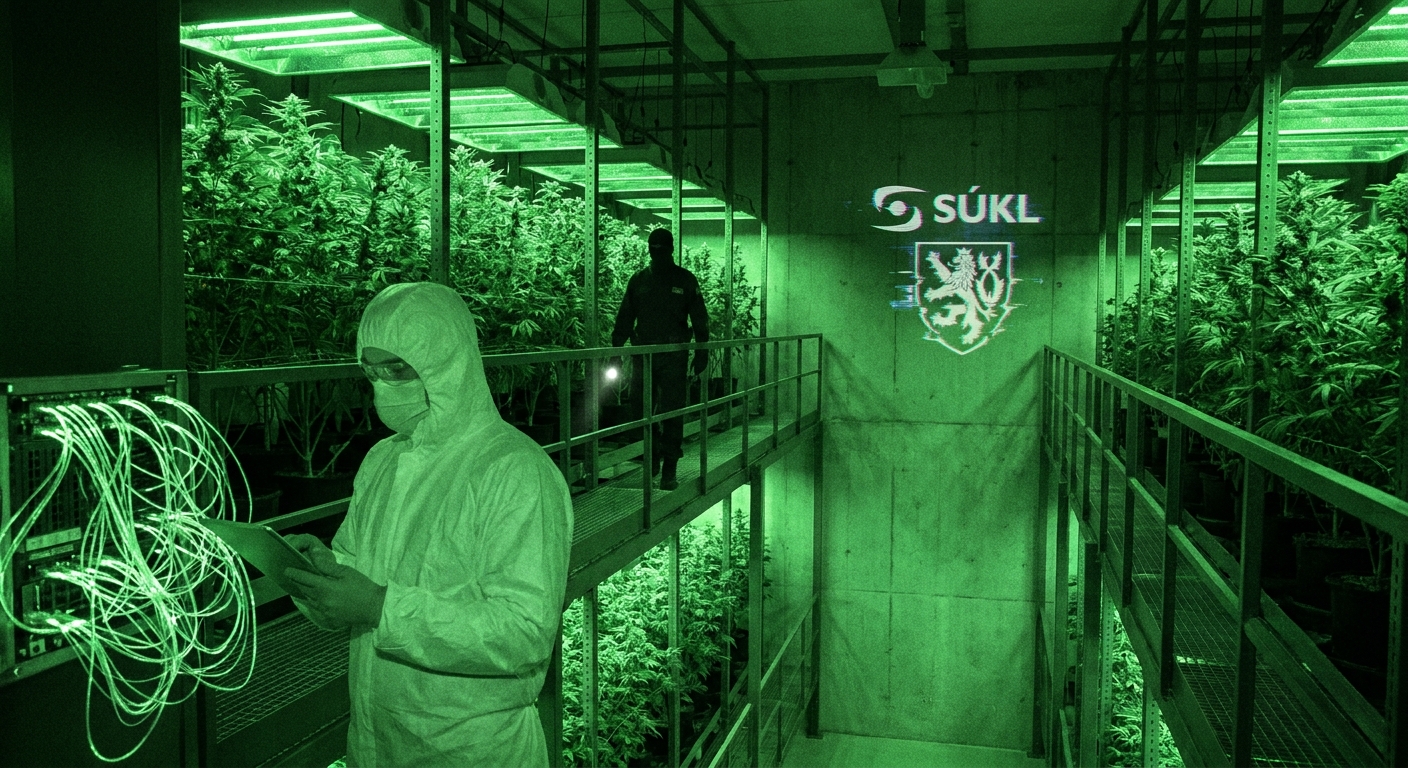
In the first nine months of 2025, Czech doctors prescribed more than 314 kilograms of medical cannabis. That’s more than the entire 318 kilograms prescribed throughout all of 2024. And on January 1, 2026, the Czech Republic added legal personal possession of up to 25 grams to a framework that was already one of Europe’s most developed. The compliance infrastructure behind this rapid growth—and the security obligations it creates—is what most analyses miss.
The Czech Republic’s cannabis story is often told as a legalization narrative. This is the compliance and cybersecurity story: what regulatory framework governs licensed operators, what data protection obligations apply to patient records, and how the November 2025 NIS2 transposition changes the security requirements for the sector.
The Regulatory Architecture: SÚKL at the Centre
The State Institute for Drug Control (SÚKL—Státní ústav pro kontrolu léčiv) is the Czech equivalent of the MHRA or FDA for pharmaceutical matters, and it is the primary regulatory body for medical cannabis. Understanding SÚKL’s role is foundational to understanding compliance obligations.
Cultivation licensing: As of early 2026, 10 entities hold SÚKL cultivation licences for medicinal cannabis. These licences require EU-GMP (Good Manufacturing Practice) certification—the same pharmaceutical-grade standard required for medicinal cannabis in Germany, the Netherlands, and Australia. Nine of the ten licensed cultivators had achieved EU-GMP certification by late 2025, placing Czech cultivators among the most compliance-mature in the European medical cannabis sector.
Prescribing authorisation: The April 1, 2025 reform expanded prescribing rights to general practitioners for chronic pain patients—previously, only specialists (neurologists, oncologists, pain specialists) could prescribe. The result: the registered prescriber count grew to 305 doctors, dramatically expanding market access. Patients can now receive prescriptions from their regular family doctor rather than navigating specialist referrals.
Patient eligibility and quantities: Eligible conditions include chronic pain, epilepsy, PTSD, cancer-related symptoms, multiple sclerosis, and others approved by the State Health Institute. Prescriptions authorise up to 30 grams per month per patient. Eligible patients receive 90% insurance reimbursement under the Czech healthcare system—a coverage level that distinguishes Czechia from most European medical cannabis markets where patients pay out of pocket.
The e-prescription rollout: Fall 2025 saw the rollout of an e-prescription smartphone application for cannabis prescriptions. This digital pathway connects prescribing doctors, the SÚKL registry, and dispensing pharmacies electronically—replacing paper prescription workflows that created documentation gaps and fraud opportunities. The e-prescription system generates a digital audit trail from the moment a prescription is issued through dispensing.
The 2026 Personal Use Framework
On January 1, 2026, possession of up to 25 grams of cannabis in public became legal for adults in the Czech Republic. Home cultivation of up to 5 plants for personal use also became legal.
Critically, this does not create legal commercial retail channels for recreational cannabis. There are no licensed recreational dispensaries. Adults who want legal cannabis for personal use must grow their own or purchase from the medical programme (if they have a qualifying condition and prescription) or obtain it through illegal channels. The legal market remains entirely medical.
This creates a two-tier compliance environment:
- Medical operators (licensed cultivators, dispensing pharmacies, prescribing clinics) face the full SÚKL regulatory framework including EU-GMP, prescription documentation, patient registry requirements, and data protection obligations
- Personal cultivators face minimal compliance requirements—legal to grow, no formal tracking or documentation required
For commercial operators, the decriminalisation of personal use is background context rather than a compliance change. The regulatory obligations are entirely on the medical side.
Data Protection: Patient Records Under Czech GDPR Implementation
EU GDPR applies in Czechia through its direct applicability as an EU regulation, supplemented by the Czech GDPR Implementation Act (Act No. 110/2019 Coll. on Personal Data Processing). The Czech Data Protection Authority (Úřad pro ochranu osobních údajů, ÚOOÚ) enforces both frameworks.
Medical cannabis patient data constitutes special category health data under Article 9 GDPR, requiring specific legal bases and heightened protection measures.
The e-prescription data flow: When a Czech GP prescribes cannabis through the digital e-prescription system, patient data flows through multiple systems:
- Doctor’s practice management system (EHR)
- SÚKL’s central prescription registry
- The e-prescription application
- The dispensing pharmacy’s system
Each of these handoffs constitutes a data transfer under GDPR, requiring documented legal bases and appropriate safeguards. The SÚKL is the data controller for the central registry; practices and pharmacies are separate controllers for their own systems; the e-prescription application provider is a processor.
This chain of data controllers and processors requires documented Data Processing Agreements (DPAs) at each link. In practice, SÚKL-licensed dispensing pharmacies are required to maintain these agreements as part of their licensing documentation.
Insurance data: The 90% insurance reimbursement pathway requires patient claim data to flow to health insurance companies. Czech health insurance is administered by state entities (VZP, largest at 57% market share) and regulated private funds. This data flow requires GDPR-compliant processing agreements between pharmacies, prescribing practices, and insurance administrators—and creates additional data controllers in the patient’s privacy exposure surface.
Breach notification: ÚOOÚ requires breach notification within 72 hours for high-risk personal data breaches, consistent with GDPR Article 33. A breach affecting the SÚKL prescription registry or a major dispensing pharmacy’s patient database would require notification and potentially individual patient notification if high risk to their rights and freedoms.
NIS2 Transposition: The New Cybersecurity Obligation for Czech Cannabis Operators
This is where Czech compliance gets genuinely new in 2025-2026: the Czech Republic transposed the EU NIS2 Directive into national law with the New Cybersecurity Act, effective November 1, 2025.
The NIS2 Directive significantly expanded the scope of entities subject to mandatory cybersecurity requirements across EU member states. In Czechia, the National Cyber and Information Security Agency (NÚKIB) administers the framework.
Who is subject to NIS2 in cannabis: NIS2 applies to “essential entities” and “important entities” in defined sectors. Healthcare is explicitly designated as an essential sector. Licensed medical cannabis cultivators and distributors operating at commercial scale fall within healthcare supply chain coverage. SÚKL-licensed cultivators—particularly those producing at scale and supplying national pharmacy networks—are likely subject to NIS2 obligations as important entities within the healthcare supply chain.
What NIS2 requires:
- Risk management measures: Documented information security policies, risk assessments, and security measures proportionate to the risks
- Incident handling: Detection, reporting, and response procedures for cybersecurity incidents
- Supply chain security: Security requirements flowing through to suppliers and service providers
- Encryption and access controls: Appropriate use of encryption for sensitive data; access management for critical systems
- Business continuity: Backup procedures and crisis management plans
For a SÚKL-licensed cannabis cultivator, NIS2 compliance means building a security programme that includes documented risk management, incident response procedures, backup and recovery capability, and supply chain security assessments of their technology vendors. This is meaningfully more demanding than general GDPR security obligations.
Incident reporting under NIS2: Significant incidents must be reported to NÚKIB within 24 hours of detection (early warning) and within 72 hours for the full incident notification. This is faster than GDPR’s 72-hour clock and requires robust incident detection capability—not just a response plan for when something obvious goes wrong.
Fines for NIS2 non-compliance: Essential entities face fines up to €10 million or 2% of global annual turnover. Important entities face up to €7 million or 1.4% of global annual turnover. These fines apply to the Czech operation regardless of the entity’s global structure.
Cybersecurity Practical Obligations for Czech Cannabis Operators
Combining GDPR, the Czech GDPR Implementation Act, and NIS2, the practical security obligations for a SÚKL-licensed cannabis cultivator or dispensing pharmacy in 2026 include:
For cultivators:
- Security risk assessment covering cultivation management systems, EU-GMP documentation platforms, and supply chain tracking
- Incident detection and 24/72-hour reporting capability to NÚKIB
- Encryption of batch records, test result data, and any patient prescription data received as part of distribution
- Business continuity plan covering production management systems
- Supplier security assessments for technology vendors with system access
- NIS2 registration with NÚKIB if within scope
For dispensing pharmacies:
- GDPR-compliant processing of patient prescription and insurance data
- Data Processing Agreements with e-prescription platform providers, insurance companies, and SÚKL
- 72-hour breach notification capability to ÚOOÚ
- Access controls limiting patient data access to authorised clinical staff
- Retention policies aligned with Czech medical records law and GDPR data minimisation
For prescribing clinics (including new GP prescribers added in April 2025):
- Secure handling of cannabis prescription data in EHR systems
- Informed consent documentation for cannabis-specific data processing
- Security of e-prescription application credentials (separate from general EHR credentials)
Why Czech Republic Matters for European Cannabis Investment
The Czech medical cannabis market grew 46% year-over-year in 2025, and the January 2026 personal possession framework positions Czechia as the next major European cannabis market after Germany. Several factors make it distinctive as an investment and compliance environment:
EU-GMP compliance at scale: Nine of ten licensed cultivators hold EU-GMP certification, which creates an exportable quality standard. Czech medical cannabis already exports to Germany and other EU markets.
Insurance coverage: 90% reimbursement through the state healthcare system means patient uptake isn’t constrained by ability to pay—a significant structural advantage over markets where patients pay out of pocket.
NIS2-ready infrastructure: The November 2025 NIS2 transposition means Czech operators who build NIS2-compliant security infrastructure are also building infrastructure that meets the cybersecurity expectations of any EU market they might export to or expand into.
For international cannabis operators evaluating European market entry, the Czech Republic’s combination of regulatory maturity, insurance coverage, and growing patient population makes it an increasingly attractive target—and its compliance requirements, while demanding, are now clearly defined.
CannaSecure provides Czech Republic cannabis compliance consulting, NIS2 readiness assessments for SÚKL-licensed operators, and GDPR implementation guidance for medical cannabis practices. Contact us to discuss your Czech market compliance programme.