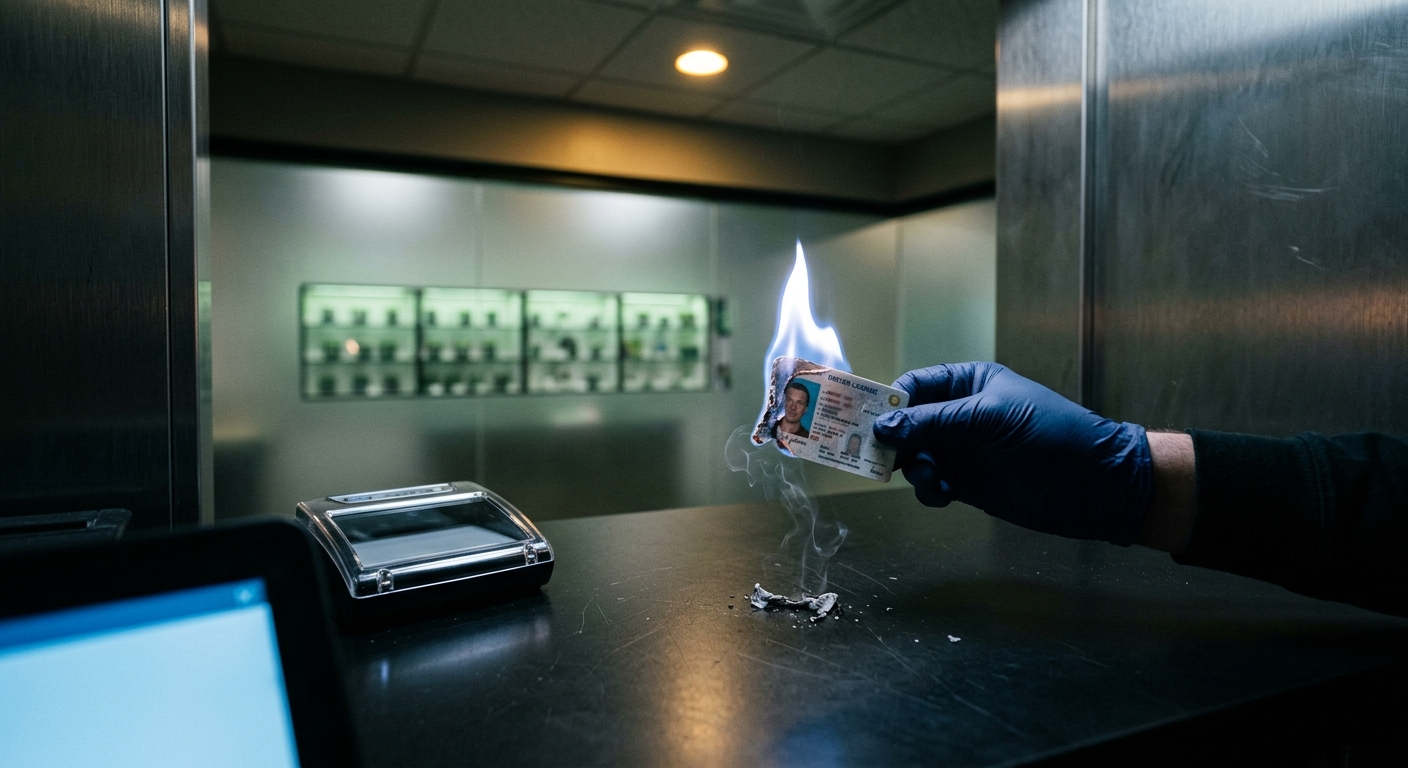
The most dangerous data in a dispensary is the data you collected for a good reason and then never deleted.
Age verification is non-negotiable in cannabis. Every legal market requires operators to confirm that a customer is of legal age, and most require some demonstration of diligence. But there is a wide gap between checking an ID and keeping a copy of it forever — and that gap is exactly where the industry’s worst privacy incidents happen. When nearly 985,000 cannabis-club members’ passports, ID cards, and selfies were found sitting on the open internet in the Cannaleaks exposure, the harm came not from the verification itself but from the retained copies of documents that had already served their only purpose.
This article is about closing that gap. The principle is simple to state and surprisingly hard to live by: verify, don’t store.
Why retained IDs are the core liability
When a breach hits a dispensary, the severity is determined almost entirely by what was kept. Consider the pattern across the industry’s biggest incidents:
- The 2020 THSuite exposure leaked the personal details of tens of thousands of cannabis users because a cloud database of dispensary records was left unsecured.
- The 2024 STIIIZY breach notified roughly 380,000 customers after names, addresses, birth dates, driver’s license numbers, and medical card details were taken through a compromised point-of-sale system.
- Cannaleaks in 2026 exposed government IDs and selfies because the age-verification pipeline retained and openly stored everything it touched.
In each case, the damage scaled with retention. A breach of “we confirmed this person was over 21 on this date” is an inconvenience. A breach of full passport scans linked to home addresses and consumption habits is a permanent harm to real people — and a regulatory catastrophe. We catalog more of these in our roundup of the biggest cannabis data breaches.
Retained identity data is also where the legal exposure concentrates. Scanning and storing the biometric and ID information on a driver’s license is precisely what has been triggering dispensary biometric privacy lawsuits. The more you keep, the larger your attack surface, your breach-notification burden, and your litigation target — all at once.
The principle: data minimization
“Data minimization” is the legal term, and it appears in nearly every modern privacy regime — GDPR’s Article 5, the CCPA/CPRA, and the wave of U.S. state privacy laws now covering 21-plus states. The shared idea: collect only what you need for a specified purpose, keep it only as long as that purpose requires, and then delete it.
Applied to age verification, minimization breaks into four questions you should be able to answer for every customer interaction:
- What is the actual requirement? In most cases it is “confirm the customer is of legal age” — not “build a permanent archive of customer identity documents.”
- What is the minimum data that satisfies it? Often a yes/no age-confirmed result and a timestamp, not a stored image.
- How long must any record be kept? Check your specific state rule. Some require a log of verification; almost none require retaining the ID image itself.
- What happens to everything else? It should be discarded at the point of verification, not parked in a database “just in case.”
A practical verify-don’t-store playbook
Here is how to implement the principle without breaking compliance.
1. Confirm what your state actually requires you to retain. This is step zero. Some jurisdictions require you to log that verification occurred; few require the underlying document. Write down the specific rule and citation for each market you operate in. Build your retention policy from that, not from your POS vendor’s defaults.
2. Prefer “scan-and-discard” over “scan-and-store.” A compliant ID scanner can validate the document, confirm age, and check authenticity without persisting the image. Configure your hardware and software so that the default is to return a pass/fail and retain a minimal log entry — not to upload and keep the photo. If your system stores images by default, that is a setting to change, not a feature to celebrate.
3. Keep a verification record, not the evidence. A defensible audit trail can be as small as: timestamp, store/terminal ID, staff member, document type, and “age confirmed: yes.” That proves diligence in an audit while holding nothing an attacker would want.
4. If you must retain images, encrypt and expire them. Where law genuinely requires retaining a document (some medical programs do), store it encrypted at rest, restrict access by role, log every read, and set an automatic deletion date that matches the legal retention period. No indefinite retention. No shared folders. No public buckets.
5. Tokenize repeat-customer and loyalty identity. For membership or loyalty programs, you do not need to re-store an ID on every visit. Verify once, store a non-reversible token or a minimal status flag, and reference that on return visits. This is how you keep the customer experience smooth without rebuilding a liability vault.
6. Interrogate the verification vendor — hard. Most operators do not run their own verification stack; they rely on a third party, exactly as the Cannaleaks clubs did. Before you trust one, get written answers: Where is the data stored? Is it encrypted in transit and at rest? Are document URLs authenticated and unguessable? Who can access it and is access logged? When is it deleted? Has the system passed an independent penetration test? A vendor that cannot answer these has already told you what you need to know. This is the same vendor-risk discipline we lay out in our seed-to-sale attack-surface analysis.
7. Run a retention audit twice a year. Pull a sample of what your systems are actually holding and compare it to what your policy says they should hold. Drift is normal; unmanaged drift is how a “we don’t keep IDs” policy quietly becomes a five-year archive nobody remembers creating.
The compliance upside
Verify-don’t-store is not only safer; it is easier to defend. An operator that retains minimal verification records has a smaller breach-notification obligation, a smaller litigation target, a faster path through a state compliance audit, and a clean answer when a regulator, insurer, or acquirer asks how it handles identity data. Cyber insurers are increasingly underwriting on exactly these controls, and data minimization is one of the cheapest, highest-leverage controls you can show them.
Contrast that with the alternative. The operators caught in the industry’s worst breaches were not, for the most part, negligent about checking IDs. They were negligent about keeping them. They confused “we verify customers” with “we archive customers,” and the archive is what got breached.
The bottom line
Age verification is a moment, not a database. The check happens, the customer is confirmed, and in almost every case the document that proved it should never live longer than the transaction. Cannaleaks, STIIIZY, and THSuite are all variations on the same mistake: an industry that had a legitimate reason to look at an ID decided to keep it, and the keeping is what hurt people.
Audit what your systems retain this quarter. Default to scan-and-discard. Keep a record of the fact of verification, not the evidence behind it. Encrypt and expire anything law forces you to hold. Do that, and the next time a verification vendor’s cloud is found wide open, you will not be one of the 985,000 names inside it.
This article is provided for informational purposes only and does not constitute legal advice.