
Cannabis payments are going digital fast. By the end of 2026, nearly half of all cannabis transactions will run over electronic payment rails. That’s a massive step forward for an industry built on cash — and a massive expansion of the financial attack surface that most operators aren’t prepared to defend.
From Cash Boxes to ACH Rails: How Fast Things Are Moving
Walk into almost any dispensary five years ago, and the payment experience was a throwback to 1975 — cash only, ATM in the corner, maybe a cashless ATM that processed debit transactions through a gray-area workaround. That era is ending at a speed the industry wasn’t expecting.
Cannabis Schedule III Rescheduling: The Cybersecurity and Compliance Changes You Need to Prepare For NowPresident Trump’s December 2025 executive order has put cannabis rescheduling on the fast track. Here’s what the shift from Schedule I to Schedule III means for your security, compliance, and operations—and what you need to do before the rules take effect. The Rescheduling Is Happening—And Soon On December Canna SecureCannaSecure
 Analysts project that nearly 42% of cannabis transaction volume will run over ACH and real-time bank payment rails in 2026, up sharply from 28% in 2025. That’s not incremental growth — that’s a fourteen-point shift in a single year, representing billions of dollars in transaction value migrating from physical cash to digital, bank-connected payment infrastructure. Dispensaries with digital payment options are already seeing up to 3x higher revenue compared to cash-only stores, creating a powerful financial incentive to accelerate the transition.
The driver is simple: major card networks — Visa and Mastercard — continue to prohibit cannabis transactions under their network rules, which forbid processing payments for federally controlled substances. ACH sidesteps those rails entirely, running bank-to-bank transfers through the federally regulated Automated Clearing House network, which has issued no prohibition on cannabis payments. The result is a compliant, traceable, cost-effective payment method that solves the cash problem without waiting for congressional action.
What ACH Actually Means for Your Payment Stack
ACH isn’t a single product — it’s an underlying payment rail that shows up in cannabis retail in several distinct forms, each with different security and compliance implications:
- Direct ACH bank debits — customers authorize a pull from their bank account at point of sale, often through a linked account established during account creation
- Pay-by-Bank / QR code payments — customers scan a dispensary-generated QR code with their banking app and approve an instant bank transfer, often powered by open banking platforms like Plaid
- ACH pre-payment for online orders — customers pay at checkout during online ordering before pickup or delivery, reducing no-shows and increasing basket sizes by up to 30%
- Cashless ATMs — technically a debit transaction that processes as a cash withdrawal; still widely used but facing increasing regulatory scrutiny as a gray-area workaround
Each of these payment flows creates a digital trail that didn’t exist in a cash transaction. That trail is enormously valuable for compliance, tax reporting, and anti-money laundering documentation. But it’s also a trail that leads directly to sensitive financial data — banking credentials, account numbers, transaction histories, customer identities — that requires serious security infrastructure to protect.
The Cost Equation: Why ACH Is Winning on Economics Alone
Part of what’s accelerating ACH adoption is straightforward unit economics. Cannabis businesses face transaction fees ranging from 2.5% to 3.95% on high-risk card alternatives. ACH processing, by contrast, typically costs 1% to 1.5% per transaction — less than half the cost of point-of-banking alternatives that can charge $2 to $3.50 per transaction.
At meaningful transaction volumes, this differential becomes material. A dispensary processing $1 million per month in transactions saves between $10,000 and $25,000 monthly by shifting from high-risk card alternatives to ACH. Across a multi-state operator running $50 million in annual revenue, the fee savings from ACH adoption can reach $1.5 million per year or more.
But the economic calculus has a hidden variable: the cost of a breach or compliance failure. Every ACH transaction connects your business to real banking infrastructure in a way that a cash transaction never did. The financial data flowing through your payment systems — customer bank account numbers, routing numbers, transaction histories, identity-verified customer records — is exactly the data that cybercriminals target, and exactly the data that financial regulators expect you to protect under frameworks like GLBA and the FTC Safeguards Rule.
Schedule III and the New Financial Compliance Overlay
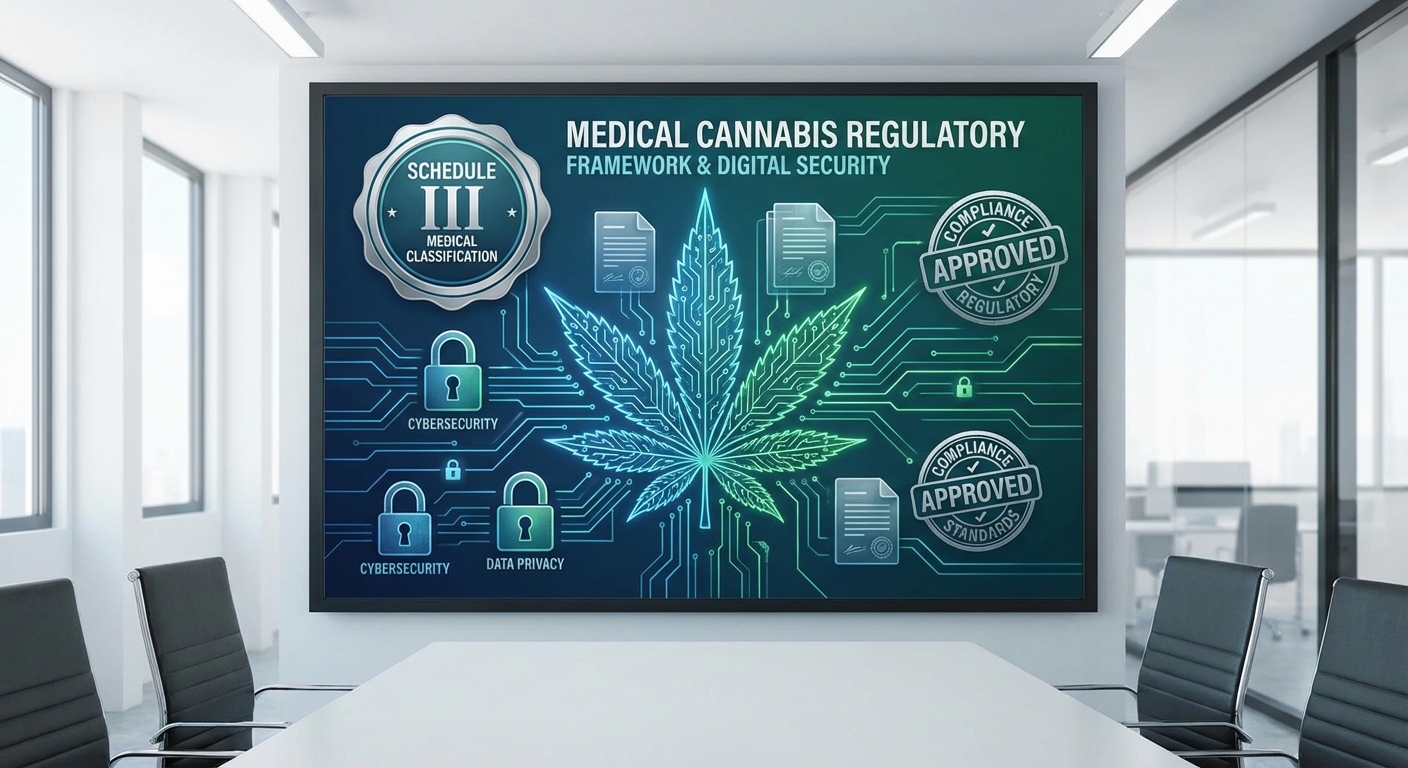
The payment security stakes are rising even further because of where federal cannabis policy is heading. Cannabis rescheduling to Schedule III — which President Trump’s December 2025 executive order directed the Attorney General to complete — does not equal legalization, but it does pull cannabis operators into the orbit of federal financial regulations that previously didn’t apply.
Under Schedule III status, cannabis businesses that gain banking access will face significantly elevated compliance scrutiny from financial institutions. Banks and payment partners will require documentation that demonstrates compliance with:
- Anti-Money Laundering (AML) controls — formal programs documenting transaction monitoring, suspicious activity reporting, and beneficial ownership transparency
- Bank Secrecy Act (BSA) recordkeeping — specific documentation standards for financial transactions that federal examiners can audit
- Beneficial ownership verification — under FinCEN’s Customer Due Diligence Rule, financial institutions must know and document who ultimately owns and controls their cannabis business customers
- IRS Section 280E transition documentation — as 280E restrictions lift under Schedule III, operators will need clean, auditable financial records that can survive IRS examination
This means the banks and payment processors enabling your ACH infrastructure aren’t just payment partners anymore — they’re compliance gatekeepers. They will require deeper onboarding documentation, ongoing transaction monitoring reports, and incident notification commitments before and after onboarding cannabis clients. If your financial data security posture doesn’t meet their standards, you lose payment access. And losing payment access in a 42%-ACH environment is a material business disruption, not an inconvenience.
The Security Architecture Cannabis ACH Payments Require
Here’s where most cannabis operators have a significant gap. Moving from cash to ACH doesn’t just require a new payment terminal or a QR code sticker on the counter — it requires a security architecture capable of protecting bank-grade financial data.
The specific technical controls that ACH payment security requires include:
Encryption in Transit and at Rest Every ACH transaction carries banking credentials and financial identifiers that must be encrypted end-to-end. TLS 1.2 or higher is the minimum acceptable standard for data in transit. Financial data stored in your systems — transaction records, linked account references, customer financial profiles — must be encrypted at rest using AES-256 or equivalent. Unencrypted financial data is not just a security risk; it’s a regulatory violation under GLBA and state financial privacy laws.
Tokenization of Sensitive Financial Data Best-practice ACH implementations replace actual bank account numbers with unique tokens in your systems — meaning the real banking credentials are held by your payment processor, not your dispensary POS or CRM. If your POS system is storing actual account numbers or routing numbers, you have an architectural problem that a breach will make very expensive.
Access Controls and Authentication Financial systems require role-based access controls ensuring that only authorized personnel can initiate, modify, or review ACH transactions. Multi-factor authentication is required for any system with access to financial data. The Ohio Marijuana Card breach — which exposed nearly one million patient records — was partly attributable to inadequate access controls on systems containing sensitive data.
Audit Logging Every ACH transaction, every access to financial records, and every administrative change to payment systems must be logged in tamper-evident audit trails. These logs are required for BSA/AML compliance, for incident response investigations, and for regulatory examinations.
Vendor Security Assessment Your ACH payment processor, open banking platform, POS system, and any integration middleware all touch your financial data. Each vendor must be assessed for security certifications (SOC 2 Type II is the baseline standard for financial data processors), breach notification commitments, and data handling practices. Under GLBA, you are responsible for your vendors’ security posture when they handle your customers’ financial data.
The Fraud Vector Nobody Is Talking About
Beyond the regulatory compliance angle, cannabis ACH payments create a specific fraud exposure that operators should understand: ACH return fraud and account takeover attacks.
Because ACH transactions pull from customer bank accounts, fraudulent or unauthorized transactions can be reversed by banks for up to 60 days after processing. A customer whose bank account credentials were compromised — or who claims a transaction was unauthorized — can trigger an ACH return that reverses the payment while your product has already left the dispensary. At scale, coordinated ACH return fraud can generate significant inventory losses with limited recourse.
More concerning is the account takeover scenario: if your loyalty program, online ordering platform, or pay-by-bank system stores linked bank account credentials and is breached, attackers gain access to your entire customer base’s banking information. This isn’t a theoretical risk — it’s the exact attack pattern that has targeted pharmacy and healthcare payment platforms in recent years, and cannabis platforms are increasingly attractive targets as transaction volumes grow.
Mitigating these risks requires velocity monitoring (flagging unusual transaction patterns), device fingerprinting, behavioral analytics on payment sessions, and strong authentication for any customer action that modifies linked payment accounts.
The GLBA Exposure Cannabis Operators Don’t Know They Have
The Gramm-Leach-Bliley Act (GLBA) is a federal financial privacy law that most cannabis operators have never heard of — and that will apply to them directly once banking access normalizes under Schedule III reclassification.
GLBA requires that any business collecting nonpublic personal financial information implement a comprehensive written information security program covering:
- Risk assessment identifying internal and external security risks to customer financial data
- Implementation of safeguards to control identified risks
- Vendor oversight ensuring service providers maintain appropriate safeguards
- Regular program evaluation and adjustment based on testing and monitoring
- Designation of a qualified security program coordinator (in practice, a CISO-level function)
The FTC’s updated Safeguards Rule — which implements GLBA for non-bank financial companies — went into effect in 2023 and significantly raised the technical bar, adding requirements for multi-factor authentication, encryption, access controls, penetration testing, and incident response planning. Cannabis operators gaining banking access under Schedule III who lack these controls will be in GLBA violation from day one.
Competitive Differentiation Through Payment Security
There’s a final dimension to this conversation that goes beyond compliance. In an industry where product differentiation is increasingly difficult and customer loyalty is hard-won, demonstrable payment security is a brand asset.
Customers choosing between two dispensaries in the same market — similar products, similar prices, similar locations — increasingly make decisions based on trust signals. A dispensary with clearly communicated security practices, transparent data handling policies, and visible investment in protecting customer financial information builds the kind of customer confidence that drives loyalty program enrollment, repeat visits, and positive word-of-mouth.
Conversely, a payment-related breach — a data exposure event that compromises customer bank account information — is an almost unsurvivable reputational event for a dispensary. Unlike a product recall or a pricing controversy, a financial data breach signals to customers that their banking credentials are at risk. The churn from that kind of event is severe, and in states with private rights of action under consumer privacy laws, the litigation exposure compounds it further.
The operators investing in payment security infrastructure now aren’t just checking compliance boxes — they’re building a competitive moat in a market where customer trust is increasingly the scarcest resource.
What to Do Now
If your dispensary or MSO is riding the ACH adoption wave without a parallel investment in payment security infrastructure, here’s where to focus immediately:
- Audit every payment touchpoint — POS systems, online ordering, delivery apps, loyalty platforms — and document what financial data each system collects, stores, and transmits
- Confirm tokenization is in place — your systems should never store raw bank account or routing numbers; confirm this with every payment vendor in writing
- Require SOC 2 Type II attestations from all payment processors and fintech integrations
- Build a written information security program that covers financial data specifically — this is a GLBA prerequisite and an increasingly common requirement for bank and payment processor onboarding
- Implement MFA across all financial systems — no exceptions for any role with access to payment data or transaction records
- Establish ACH fraud monitoring with automated velocity rules and unusual pattern alerts
- Get a penetration test on your payment infrastructure before regulators or attackers find the vulnerabilities first
cannasecure.tech helps cannabis operators build the security programs that financial institutions, regulators, and customers require in 2026 — including GLBA compliance, payment security architecture, and ACH fraud mitigation. Schedule a payment security assessment today.